


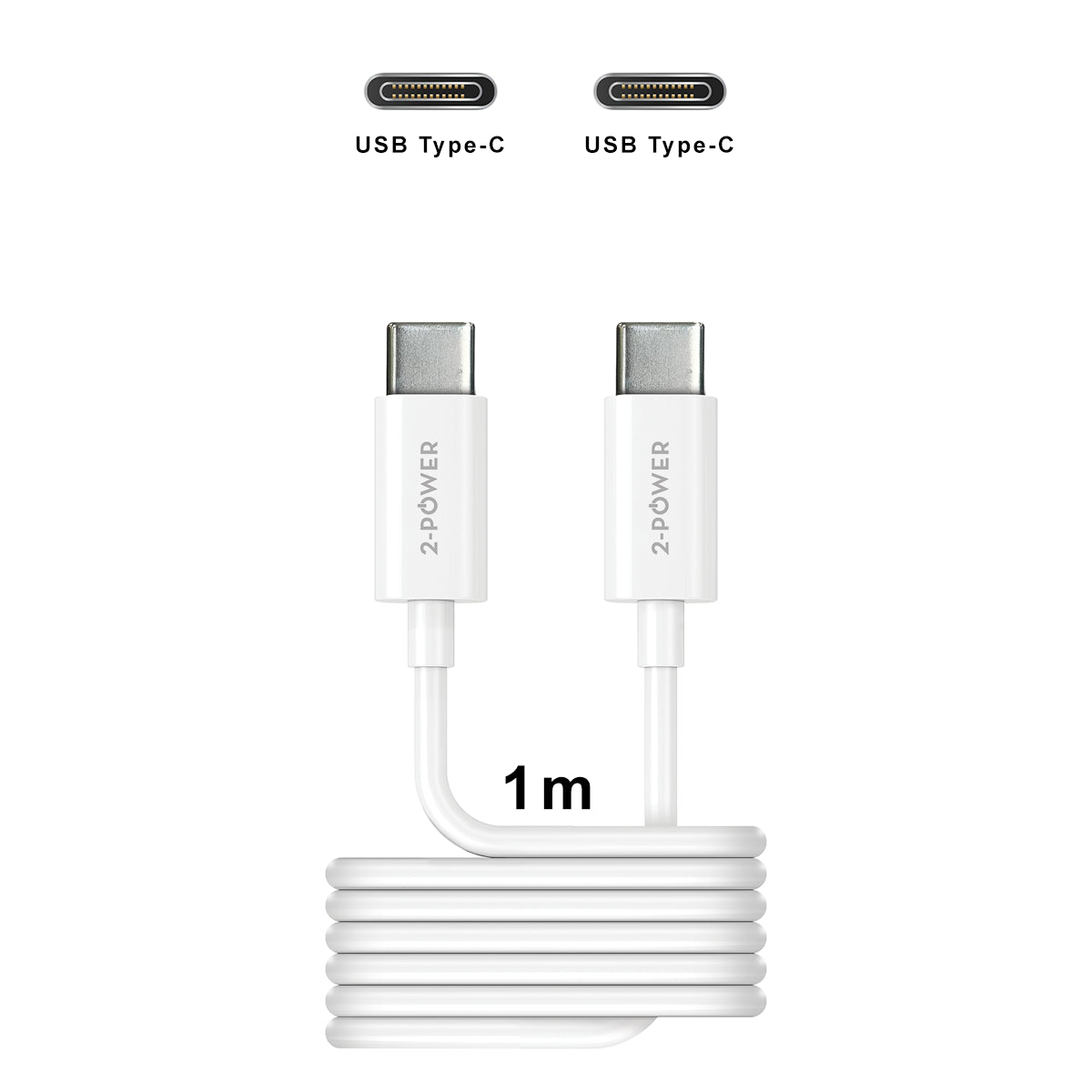
2-Power 1m 36w USB Cable USB-C to USB-C for Data and Charging
When you reach for the same cable every morning to top up your phone, sync files from a camera, or keep a tablet charged through the day, build quality stops being an abstract spec and becomes the difference between a tool that lasts and one that frays, shorts, or simply stops working after a few months. This 1-metre USB-C to USB-C cable is engineered to survive that daily rhythm, not through marketing claims, but through material choices and construction methods that address the specific failure modes cheap cables exhibit in real-world use.
Engineered for Longevity, Not Just Compliance
The cable's internal architecture uses a woven reinforcement layer that distributes mechanical stress across the length of the conductor bundle, rather than concentrating it at the connector junction where most cables fail. That woven core is shielded to suppress electromagnetic interference, the kind that causes intermittent data dropouts or slow charging when the cable is coiled near other electronics. The connectors themselves are precision-machined and plated to maintain consistent contact pressure over thousands of insertion cycles, so the connection doesn't degrade into the intermittent "wiggle it until it works" state that signals the end of a cable's useful life. The outer jacket is tangle-resistant, which matters more than it sounds: cables that knot easily get yanked harder during separation, accelerating strain damage at the solder points inside the plug housing.
Every element is specified to UK standards, which in practice means the cable has passed the thermal, mechanical and electrical tests that confirm it won't become a fire risk when left plugged in overnight, won't short when flexed repeatedly at the same angle, and won't deliver inconsistent current that confuses a device's charge controller. These are baseline safety expectations, but they're not universal, the market is full of cables that meet none of them.
Dual-Function Capability: Charging and Data in One Cable
Many budget USB-C cables are charge-only, with the data lines either absent or inadequately shielded. This cable supports both functions. That means you can use the same cable to pull a day's worth of photos off a camera's USB-C port and then charge the camera overnight, or sync a large file to a tablet and immediately top up its battery, without swapping hardware. Data transfer runs at speeds appropriate to the USB-C 2.0 specification, which handles document libraries, photo batches and music collections without the multi-hour waits associated with older USB standards.
When paired with a compatible charger, the cable supports up to 36 watts of power delivery across the voltage profiles required by modern smartphones, tablets, compact cameras, portable audio gear, and handheld gaming devices. That's enough to charge a typical smartphone from flat to 50 percent in around half an hour, or to keep a tablet running while it's being used for navigation, video playback, or tethered shooting. The 36-watt ceiling is a deliberate choice: it covers the vast majority of personal electronics without requiring the thicker gauge conductors and more complex power negotiation circuitry of 60-watt or 100-watt cables, which makes this cable lighter, more flexible, and less prone to the stiffness that causes kinking.
For applications where higher wattage or greater length is required, charging a laptop at a desk some distance from the wall socket, for instance, the same manufacturer offers 100-watt variants in 1-metre and 2-metre lengths. But for the day-to-day task of keeping phones, cameras, and tablets charged and synced, 36 watts at 1 metre hits the sweet spot between capability and handling.
Connector Design and Case Compatibility
The USB-C plugs are slim-profile with rounded edges, which allows them to mate with devices inside most protective cases without requiring you to remove the case first. The connector housing is compact enough to clear the raised lips and recessed ports common on rugged cases, slim cases with tight tolerances, and flip-style cases with port cutouts. There are edge cases, cases with unusually thick bezels, irregular port surrounds, or non-standard cutout shapes, where fitment may be tight or require case removal, but these represent a small minority of the case designs in active use.
The plug housings are reinforced at the strain-relief point where the cable exits the connector, which is the failure zone on cables that lack proper mechanical design. Repeated flexing at this junction, the inevitable result of plugging and unplugging a cable while it's under slight tension, or coiling it for storage while the plug is still attached to a device, creates fatigue cracks in the conductor insulation. The reinforced strain relief distributes that flex over a longer section of cable, reducing the peak stress and extending the cable's working life well beyond the point where a non-reinforced design would exhibit exposed wiring or intermittent connectivity.
Warranty and Quality Assurance
The cable is backed by a two-year limited warranty, which functions as a quality signal: manufacturers do not offer multi-year coverage on products they expect to fail within that period. The warranty reflects confidence in the cable's ability to withstand the mechanical and electrical stresses of daily use, the plug-unplug cycles, the coiling and uncoiling, the occasional snag on a bag zip, the voltage transients from wall chargers of varying quality, without degrading into unsafe or unreliable operation.
For buyers who need a USB-C cable that will charge and sync reliably, fit their existing case, and survive the kind of use that kills cheaper cables in six months, this 1-metre option delivers the build quality and electrical performance that turns a disposable consumable into a multi-year tool. The product code for this cable is 2PUC1M04W.