


Charger for Sony NP-BX1 Battery by Duracell
Power Management for Sony NP-BX1 Systems
This Duracell charger addresses a practical gap in Sony's compact camera ecosystem: the single-battery charging limitation of the factory solution. When you're running multiple NP-BX1 cells across a day's shoot, common with the RX100 series, HX and WX compacts, or action cameras like the AS and FDR models, having only one charging bay creates a bottleneck. This unit lets you stage batteries efficiently, rotating through spares while one body stays active.
The design prioritises location work. At under 50 grams, the charger disappears into a camera bag's accessory pocket without adding noticeable weight to a daypack or pelican case. The footprint is smaller than a deck of cards, making it viable for travel kits where every cubic centimetre counts. Unlike mains-dependent chargers that anchor you to a wall socket, this unit draws power via USB input, which fundamentally changes where and when you can top up cells.
USB Power Flexibility
The USB input specification opens up charging scenarios the original Sony BC-TRX charger cannot address. In a vehicle, the charger runs from a 12V adapter or any USB port in modern cars. On a multi-day shoot, a 20,000mAh power bank will cycle through several NP-BX1 cells without needing mains electricity. In a hotel room abroad, the same USB cable that charges your phone powers the battery charger, no travel adapter required, no voltage conversion guesswork. The input accepts 100-240V via any standard USB power supply, so the charger works in every country without modification.
This flexibility matters most when shooting away from infrastructure. Documentary work, destination weddings, multi-day hikes with a compact camera as the B-cam, situations where mains access is intermittent but a laptop, car, or power bank is always within reach. The charger becomes part of a modular power system rather than a fixed-location accessory.
Protection Circuitry
Duracell integrates three-layer protection into the charging circuit: overvoltage cutoff, overcurrent limiting, and short-circuit detection. These are not marketing features; they are the difference between a charger that safely terminates a charge cycle when the cell reaches 4.2V and one that continues pushing current into a full battery, degrading its lifespan or worse. The protection board monitors input voltage fluctuations, relevant when charging from a car's USB port, which can spike during engine start, and prevents those transients from reaching the battery.
The practical outcome: you can leave batteries charging overnight from a power bank, or plug the unit into an unfamiliar USB supply in a foreign country, without the low-level anxiety that comes with unprotected third-party chargers. The circuitry handles edge cases so you don't have to babysit the process.
Charge Status Indication
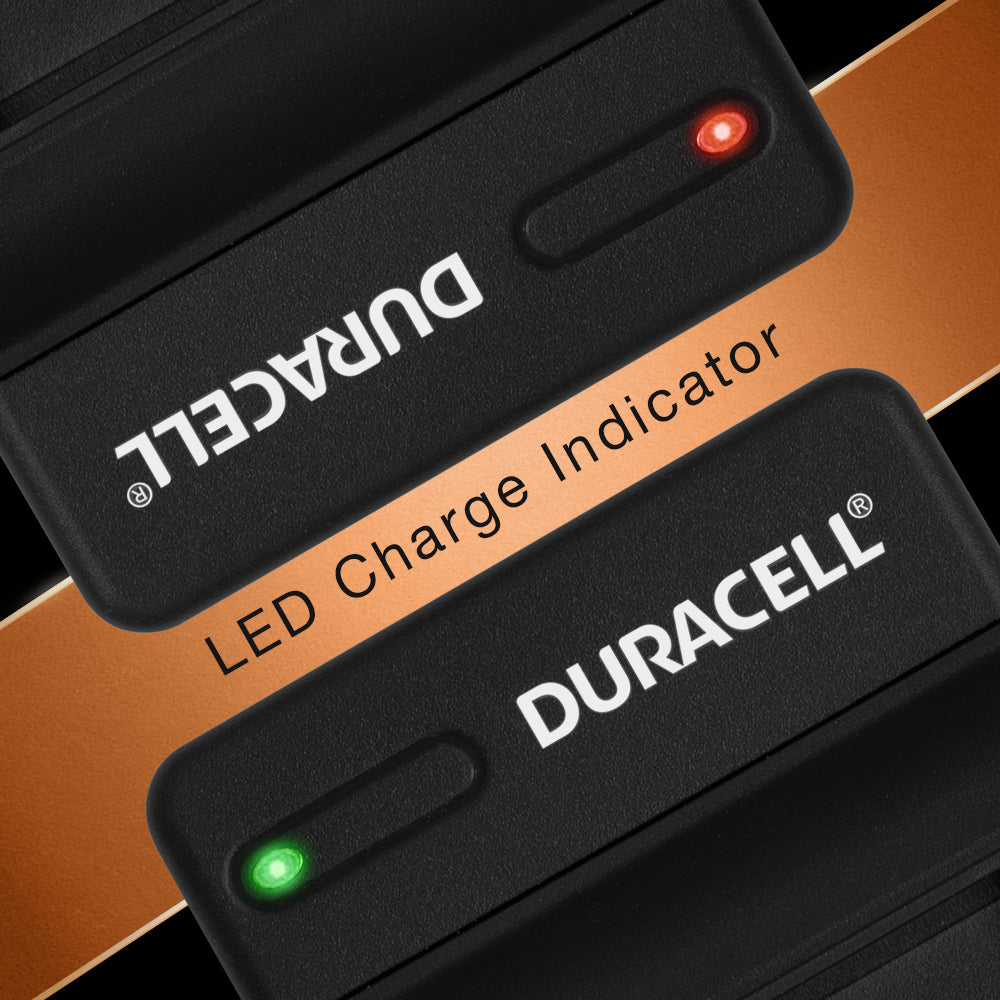
An LED indicator on the charger face displays charging progress. Red during active charging, green when the cell is full. Simple, unambiguous, readable across a room. This matters when you're staging multiple batteries and need to know at a glance which cells are ready to rotate into a camera body. The indicator eliminates guesswork, no need to pull a battery and test it in the camera to see if it's charged.
Replacement and Expansion Use Cases
This charger serves two distinct needs. First, as a direct replacement for a lost or damaged original Sony BC-TRX unit, at a lower cost than the OEM part. Second, as an additional charger for photographers and videographers who've accumulated multiple NP-BX1 batteries and need to charge more than one at a time. If you're running three or four spare cells on a wedding shoot, having two chargers means you can keep two batteries cycling while two are in use or on standby. The time saved over sequential charging compounds across a busy shooting schedule.
For hybrid shooters using a Sony compact alongside a primary mirrorless body, common with the RX100 VII as a gimbal or drone camera, this charger integrates into an existing USB charging workflow. One multi-port USB hub can power this unit, a phone, and a mirrorless battery charger simultaneously from a single mains outlet or large power bank.
Warranty and Duracell Backing
The charger carries a three-year limited warranty, which is longer than many third-party equivalents and reflects Duracell's confidence in the build quality. The warranty covers manufacturing defects and component failure under normal use. It does not cover damage from misuse, but it does mean that if the charging circuit fails within three years, the unit is replaced. That's meaningful for working professionals who depend on their charging infrastructure and cannot afford downtime from a failed component.
Duracell's reputation in power management, built over decades in the battery market, extends to this charger. The brand does not put its name on products that fail in the field. This is not a generic charger with a logo slapped on; it is a Duracell-engineered product designed to the same reliability standards as the company's battery cells.
Compatibility and Fit
The charger is built specifically for Sony NP-BX1 batteries. The charging bay matches the cell's form factor and contact layout, ensuring correct polarity and secure seating. It will not charge other Sony battery models, and attempting to force a different cell into the bay will not work, the physical design prevents cross-compatibility errors. This is a purpose-built tool for one battery type, which eliminates the compromises inherent in universal chargers.
If your kit includes any Sony camera that runs on the NP-BX1, the RX100 series I through VII, the RX0 and RX0 II, the HX90V, HX80, HX60V, HX50V, WX500, WX350, AS100V, AS50, FDR-X3000 or HDR-AS300, this charger integrates directly into your workflow. It charges Duracell equivalent NP-BX1 cells as well as original Sony batteries, so it works with whatever mix of OEM and third-party cells you've accumulated.
The Duracell charger for Sony NP-BX1 batteries is available now under SKU DRS5963.