


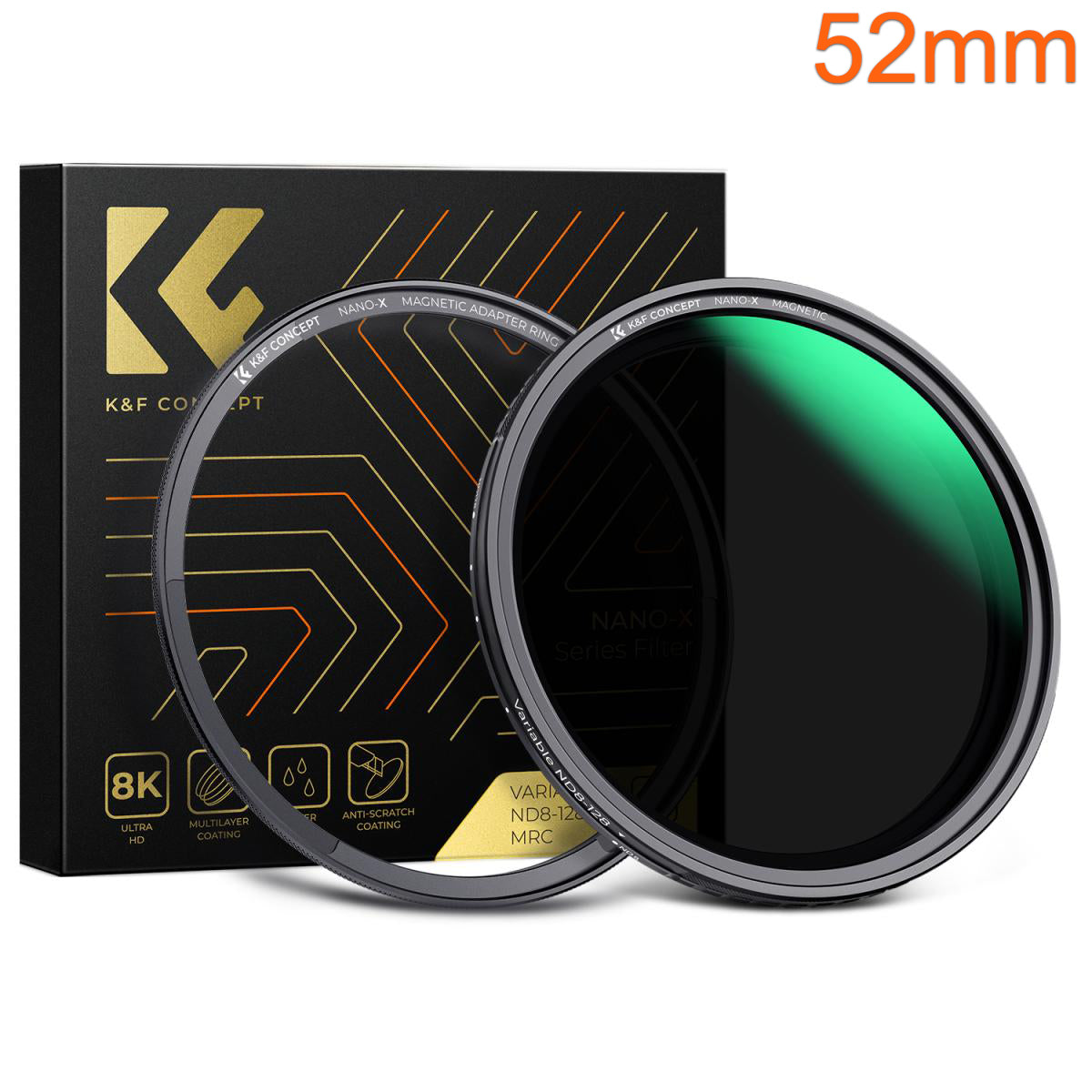

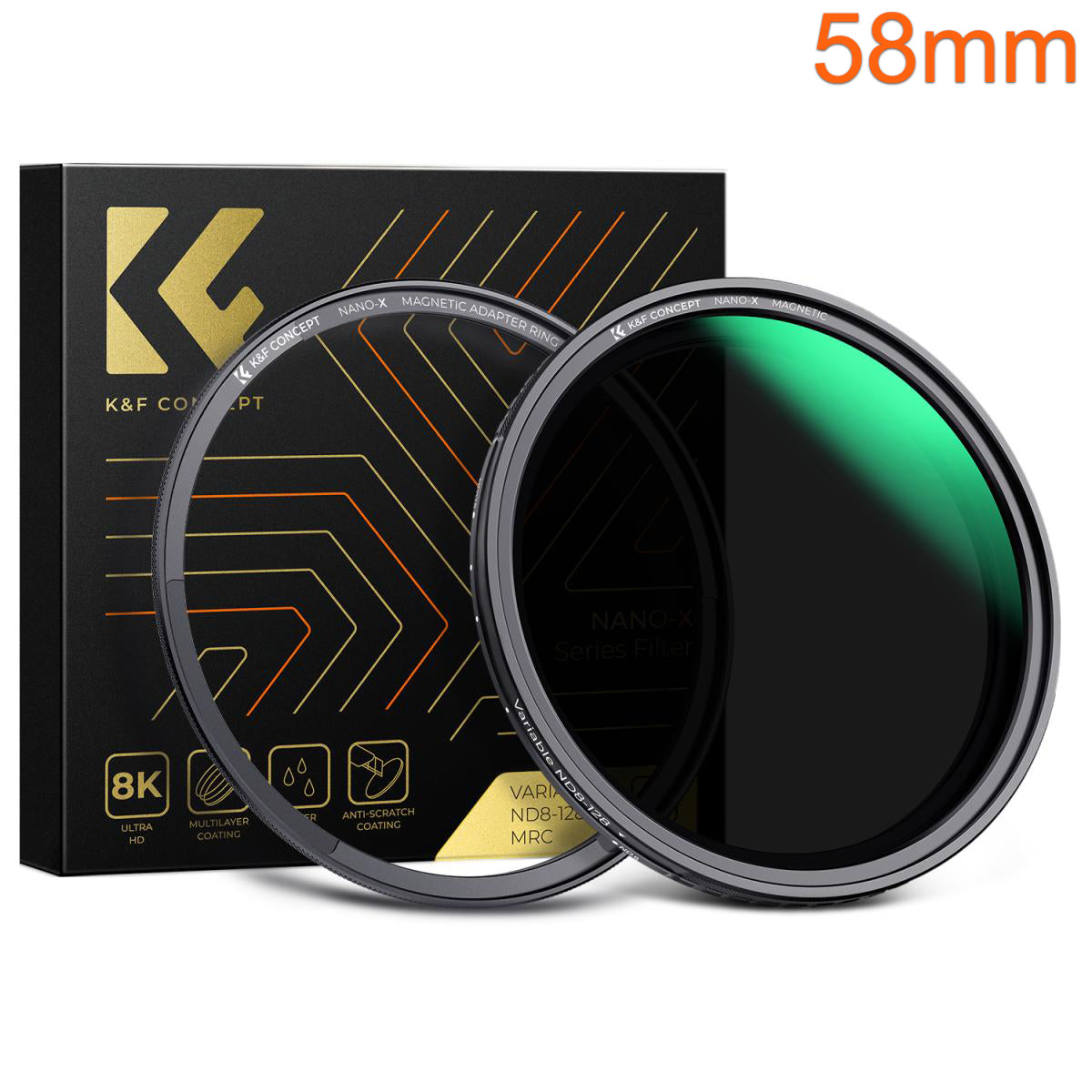
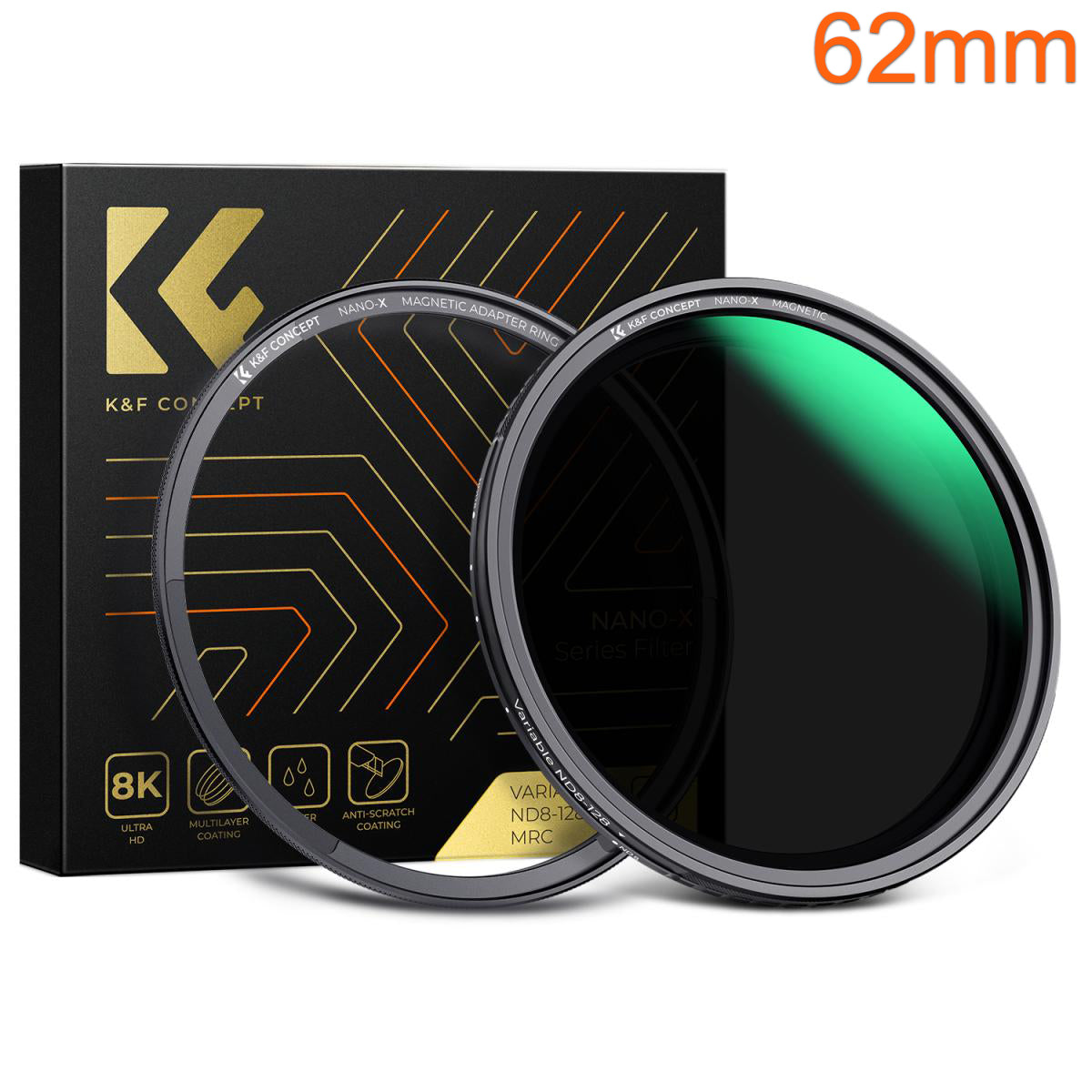

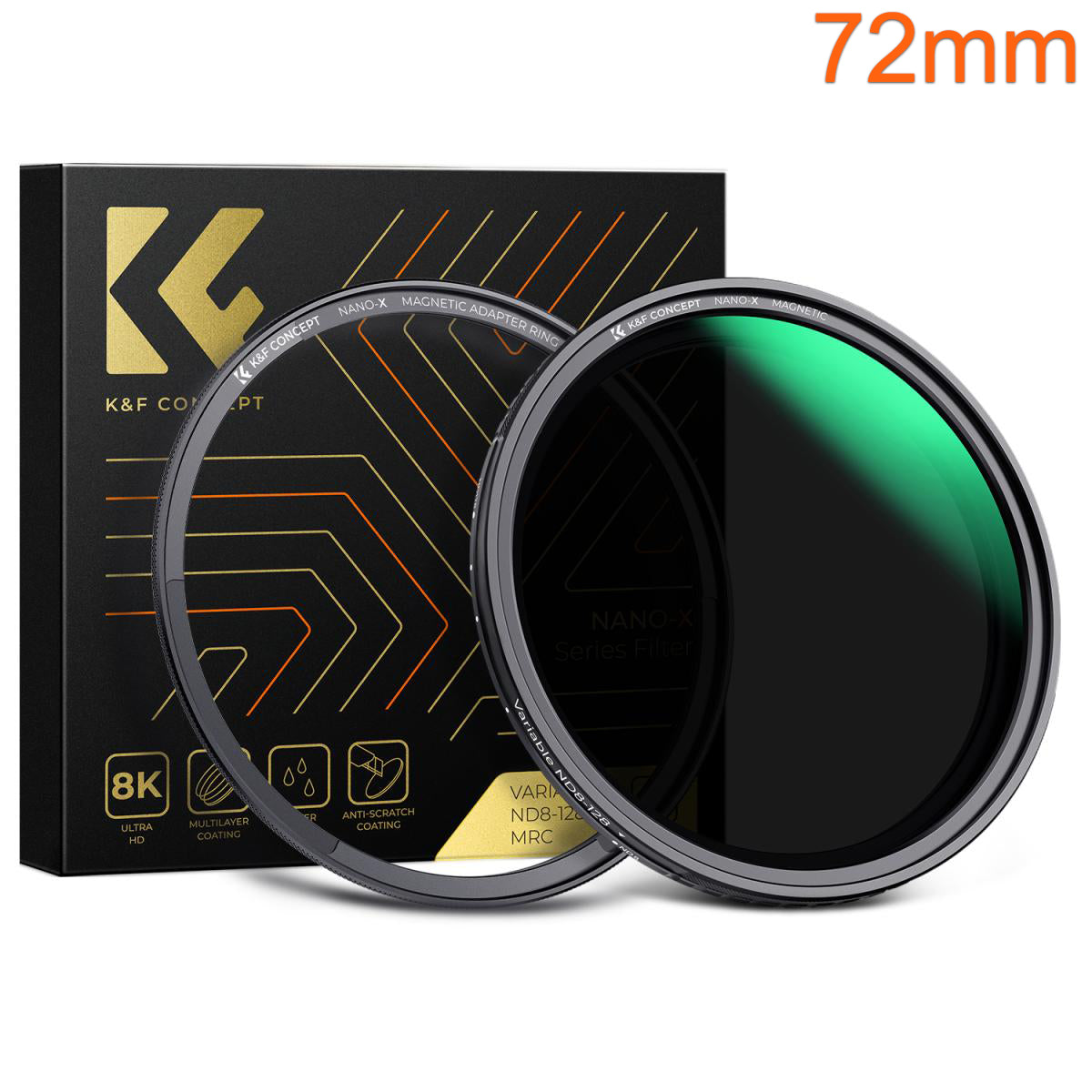
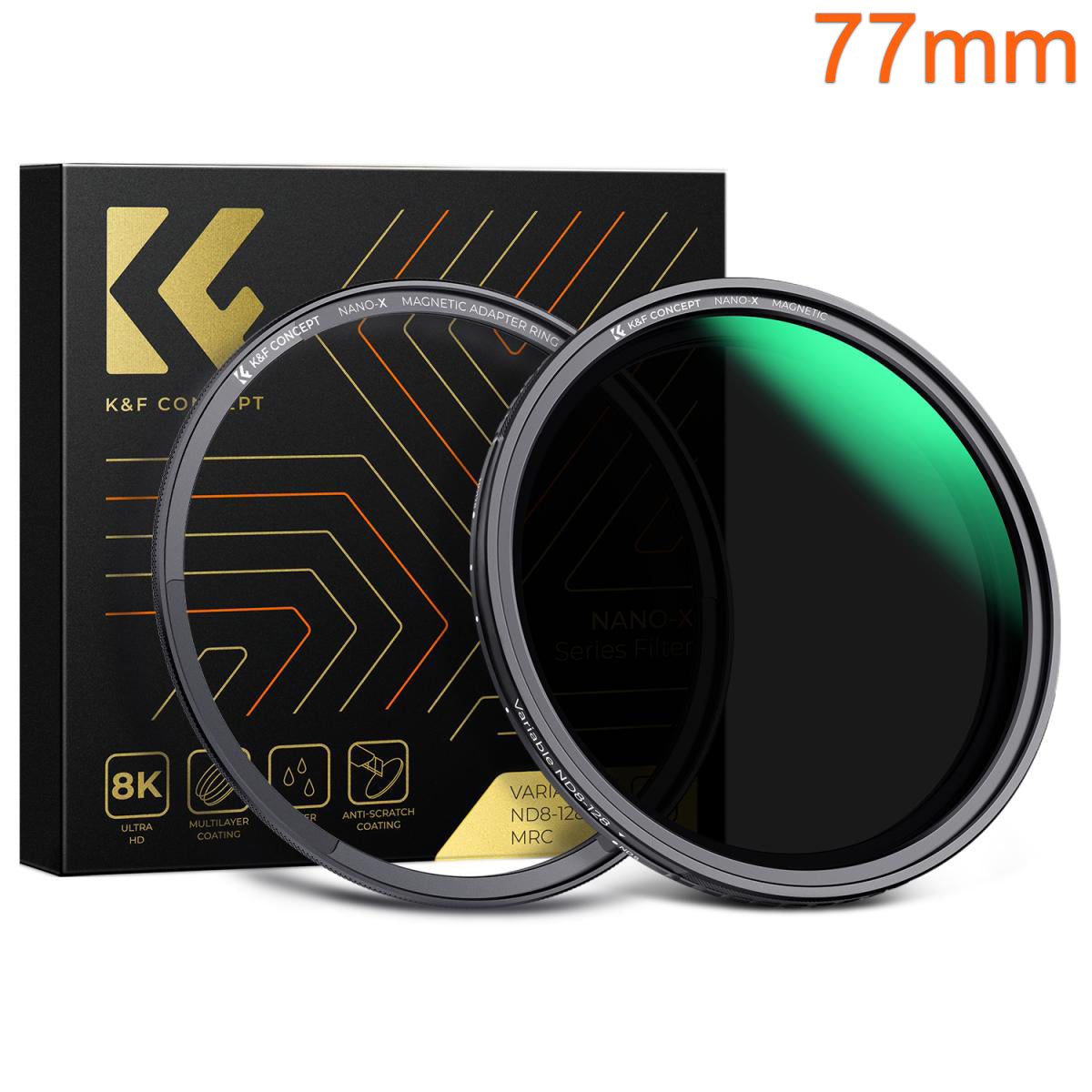
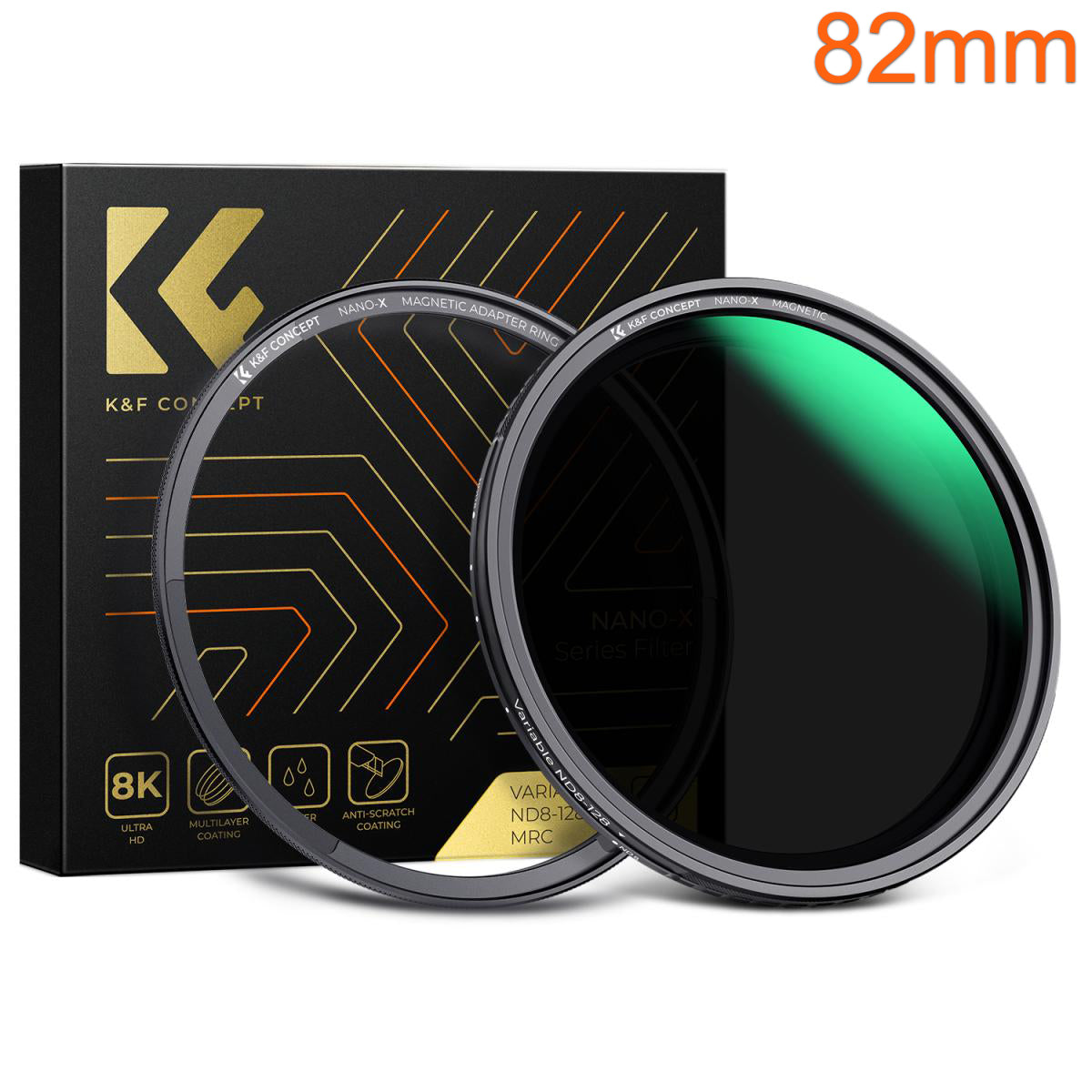
K&F ND8-128 Magnetic Variable ND Filter 3-7 Stops Nano-X Series
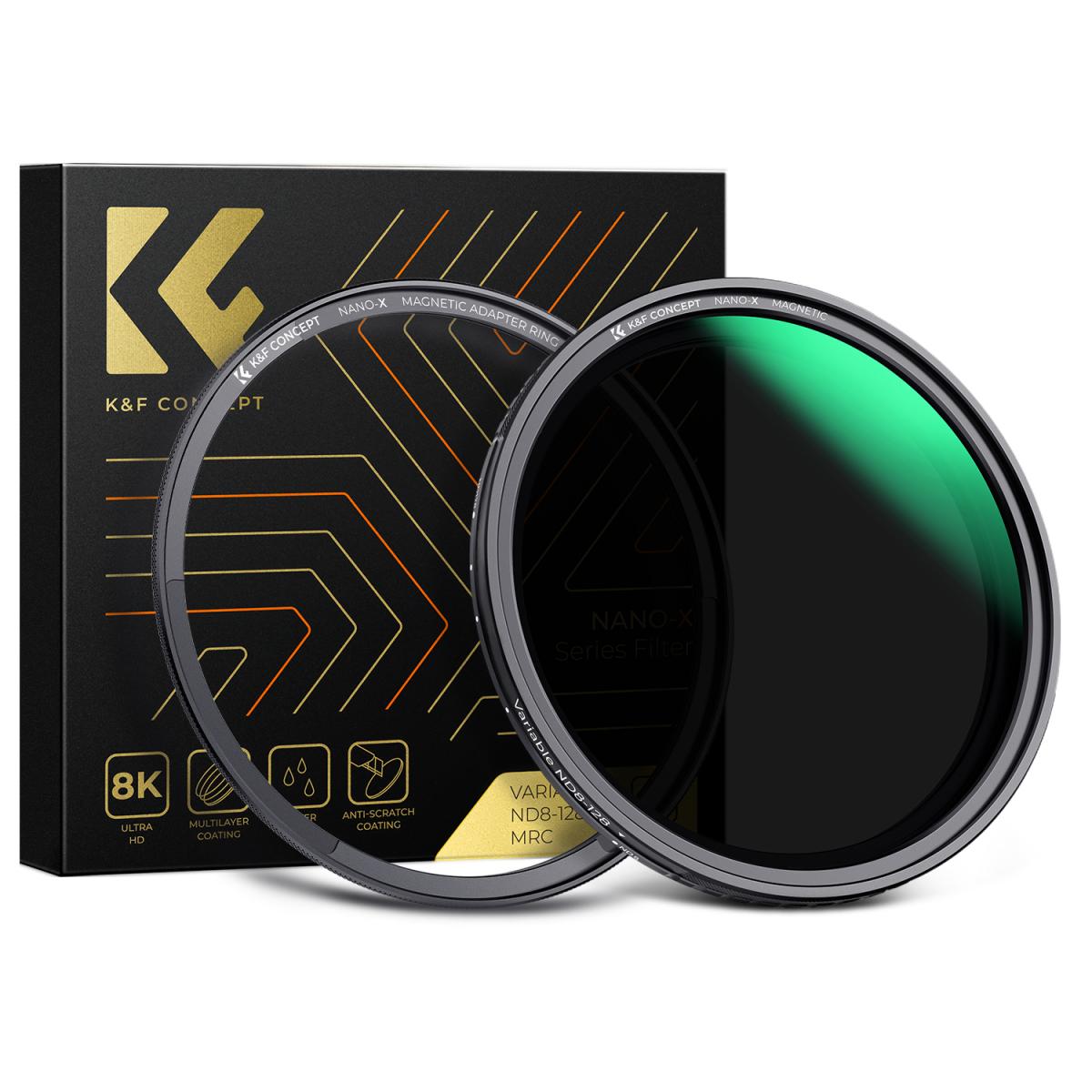
Exposure control becomes a genuine creative tool when you can dial in exactly how much light reaches the sensor. This variable neutral density filter from K&F Concept's Nano-X range delivers 3 to 7 stops of adjustable light reduction, enough latitude to shoot wide open in midday sun or stretch shutter times into the multi-second range without stacking multiple fixed-density filters. The adjustment happens by rotating the front element, which varies the density continuously across the ND8 to ND128 range. That span covers most field scenarios: motion blur in bright conditions, shallow depth of field for environmental portraits under harsh overhead light, or maintaining your preferred aperture for video when the scene is flooded with daylight.
Magnetic attachment replaces the traditional screw-mount workflow. A slim aluminium adapter ring threads onto the lens once and stays there; the filter itself snaps on and off magnetically, holding securely enough to rotate for density adjustment but releasing instantly when you need to swap or stow it. The magnetic cap accessory works whether the filter is mounted or removed, so you can protect the front element without dismantling the entire stack. This system eliminates the fumbling that leads to dropped filters, the most common cause of damage in the field, and cuts changeover time to a fraction of what threaded filters demand.
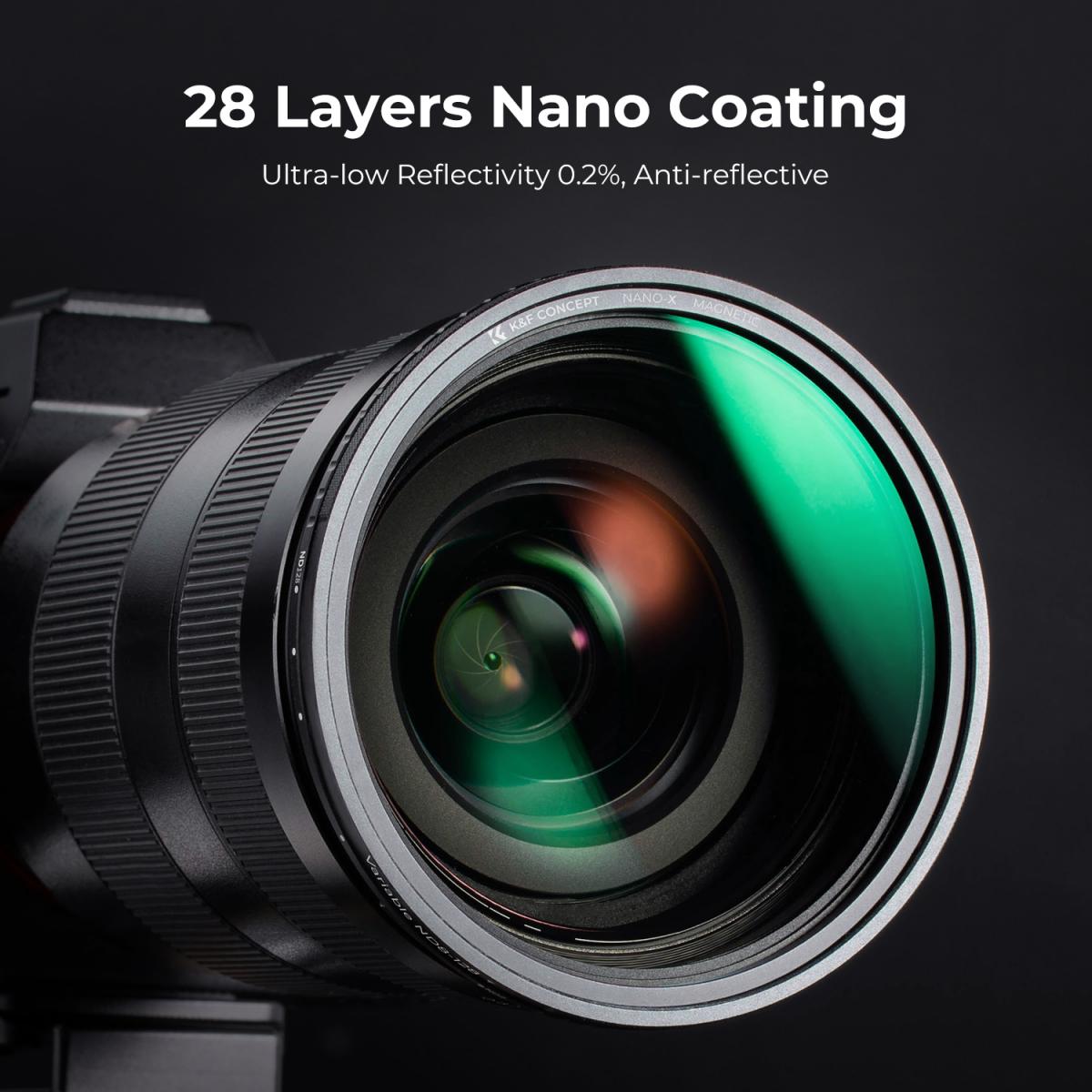
Japanese AGC optical glass forms the filter element, polished on both faces to maintain edge-to-edge sharpness at resolutions up to 8K. Twenty-eight coating layers are applied across both surfaces: anti-reflection treatments to preserve contrast and suppress flare, plus a hydrophobic outer layer that sheds water and resists fingerprints. The glass diameter exceeds the threaded mount, which pushes vignetting out of frame even on wide-angle lenses and ensures the density effect remains uniform from centre to corner. The 7.4mm aluminium frame is double-threaded, so you can stack a second filter or screw on a lens cap if the magnetic cap isn't to hand.
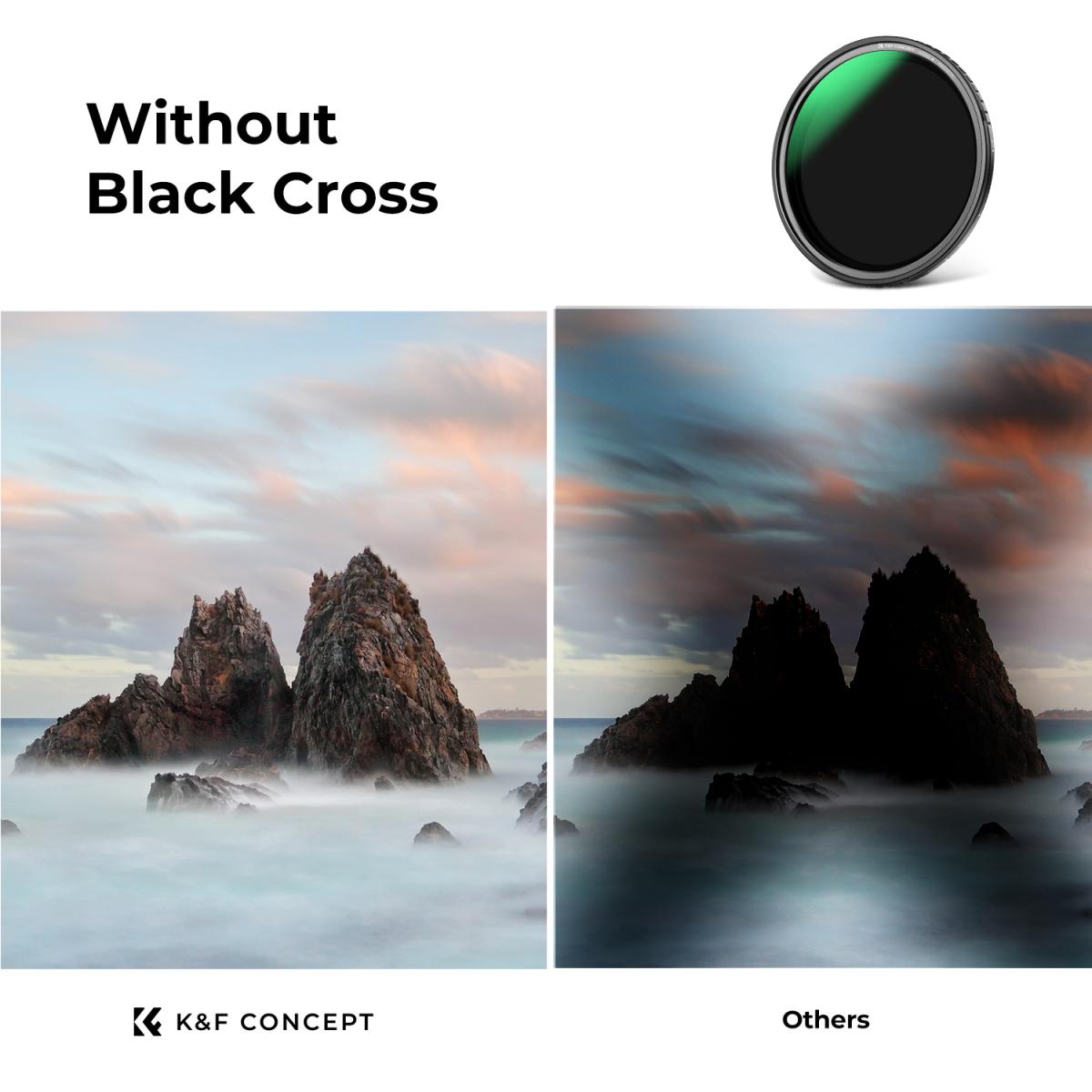
Variable ND filters work by layering two polarising elements and rotating one relative to the other. At extreme rotation angles, some designs produce a dark cross pattern, the "X effect", that renders the frame unusable. This Nano-X model is engineered to avoid that artefact across its entire 3-to-7-stop range, so you can dial in maximum density without checking the viewfinder for cross-hatch shadows. If your work involves long exposures at the upper end of the density range, coastal seascapes, architectural studies, daytime light trails, that freedom matters.
The practical advantage of a variable ND over a set of fixed-density filters is workflow speed and pack weight. A single variable filter replaces three or four fixed options, and you adjust density in real time as light conditions shift rather than unscrewing one filter and threading on another. For run-and-gun video work, it functions as an aperture substitute: many cinema lenses lack stepless iris control, so the ND becomes the tool you reach for to maintain motion blur at 180-degree shutter while exposure fluctuates. For stills, it reopens creative aperture and shutter choices in conditions that would otherwise force you into small apertures and fast shutter speeds, think f/1.4 environmental portraits at noon, or 2-second exposures of moving water under midday sun.
Motion blur is the most immediate visual payoff. Slowing the shutter to 1/15 s or longer while a variable ND holds exposure in check lets you render moving subjects, pedestrians, vehicles, flowing water, as streaks or soft blur against static elements. The effect separates cleanly from the background because the ND allows you to keep the aperture wide enough for shallow depth of field, so the blurred motion sits in a plane of focus that the static background does not share. That combination, motion blur plus selective focus, is difficult to achieve in bright light without a variable ND, because you run out of shutter and aperture headroom.
Shallow depth of field in bright conditions is the second major use case. If you want to shoot a subject at f/1.4 or f/2 outdoors in full sun, even at base ISO and your camera's fastest shutter speed you'll clip highlights. Adding 5 or 6 stops of ND brings exposure back into range, so you can maintain the aperture that gives you the background separation you're after. This matters for environmental portraits, product shoots on location, or any scenario where you want the subject isolated against a soft, out-of-focus background but the available light is too strong to permit a wide aperture.
For video, the variable ND solves the aperture-shutter-ISO triangle in a way that preserves motion cadence. The 180-degree shutter rule, shutter speed set to double the frame rate, produces natural motion blur, but it locks one leg of the exposure triangle. ISO should stay at native or near-native to avoid noise, which locks the second leg. That leaves aperture as the only variable, and many lenses don't offer smooth, clickless aperture control. A variable ND gives you a fourth control axis: you set aperture for the depth of field you want, lock shutter to the 180-degree rule, keep ISO at base, then adjust the ND to bring exposure into spec as the scene brightness changes. It's faster and less disruptive than changing aperture mid-take.
The magnetic adapter ring threads onto your lens once and remains in place. Confirm your lens's filter thread diameter before ordering, it's printed on the lens barrel or inside the lens cap, always preceded by the ⌀ symbol. Once the adapter is seated, the filter snaps on magnetically and rotates freely to adjust density. The magnetic hold is firm enough that the filter won't shift during normal handling or rotation, but it releases cleanly when you pull it off. If you're working in conditions where you need to add or remove the ND frequently, moving between sun and shade, or alternating between stills and video, the magnetic mount cuts changeover time to a second or two.
The Nano-X series is positioned for high-resolution capture. The double-sided polishing, multi-layer coatings, and oversized glass diameter are all engineered to maintain image quality at 8K, which means they're comfortably over-specced for 4K video or 24-megapixel stills. The coatings reduce internal reflections that cause flare and ghosting, and the hydrophobic outer layer means water beads off rather than spreading into a film that degrades contrast. Scratch resistance extends the working life of the filter, which matters if you're shooting in dusty, sandy, or coastal environments where abrasive particles are unavoidable.
Streamlining your kit is a secondary but real benefit. Carrying one variable ND instead of a set of fixed filters, ND8, ND16, ND64, ND128, saves pack space and reduces the number of items you need to keep track of in the field. It also reduces the number of times you need to handle the filter, which reduces the cumulative risk of drops, fingerprints, or cross-threading. The magnetic system further reduces handling risk because you're not screwing and unscrewing a threaded ring every time you want to add or remove the filter.
This filter is part of K&F Concept's engineering-led approach: solve a field problem with a design choice that makes the tool faster or more reliable to use, then price it so the solution is accessible to working photographers and videographers who don't have unlimited budgets. The magnetic mount, the X-effect suppression, and the Nano-X optical spec all address real pain points, slow filter changes, unusable frames at high density, image degradation at high resolutions, without requiring you to spend at the top end of the market. If you're looking to add variable ND capability to your kit, or replace a screw-mount variable ND with a faster magnetic system, this Nano-X model delivers the core functionality at a price point that makes sense for enthusiasts and professionals alike. Order the K&F Concept Nano-X Magnetic Variable ND Filter, KF01.1973-1981, and add a fourth exposure control axis to your shooting workflow.