






K&F ND3-1000 Variable ND Filter (VND) 1.5-10 Stops Nano-X Series
When ambient light dictates your exposure settings instead of your creative intent, you've hit the fundamental constraint every outdoor shooter knows: bright conditions force compromises. Fast shutter speeds freeze motion you wanted to blur. Stopped-down apertures extend depth of field you wanted shallow. The K&F Concept Nano-Xcel Variable ND Filter solves that constraint by giving you 1.5 to 10 stops of continuously adjustable light reduction in a single optic, so the scene's brightness no longer determines your technical choices.
Continuous Density Adjustment Across a Working Range
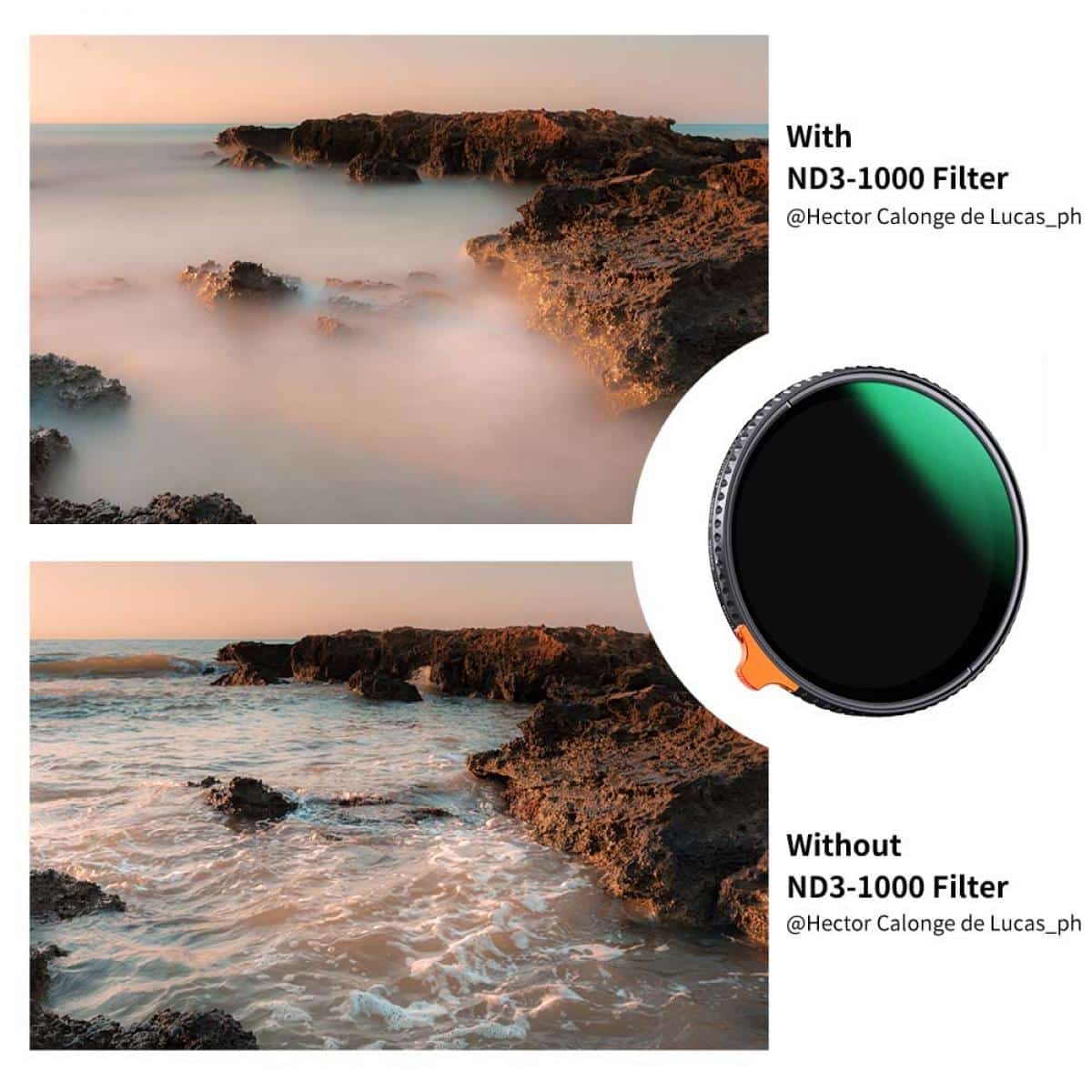
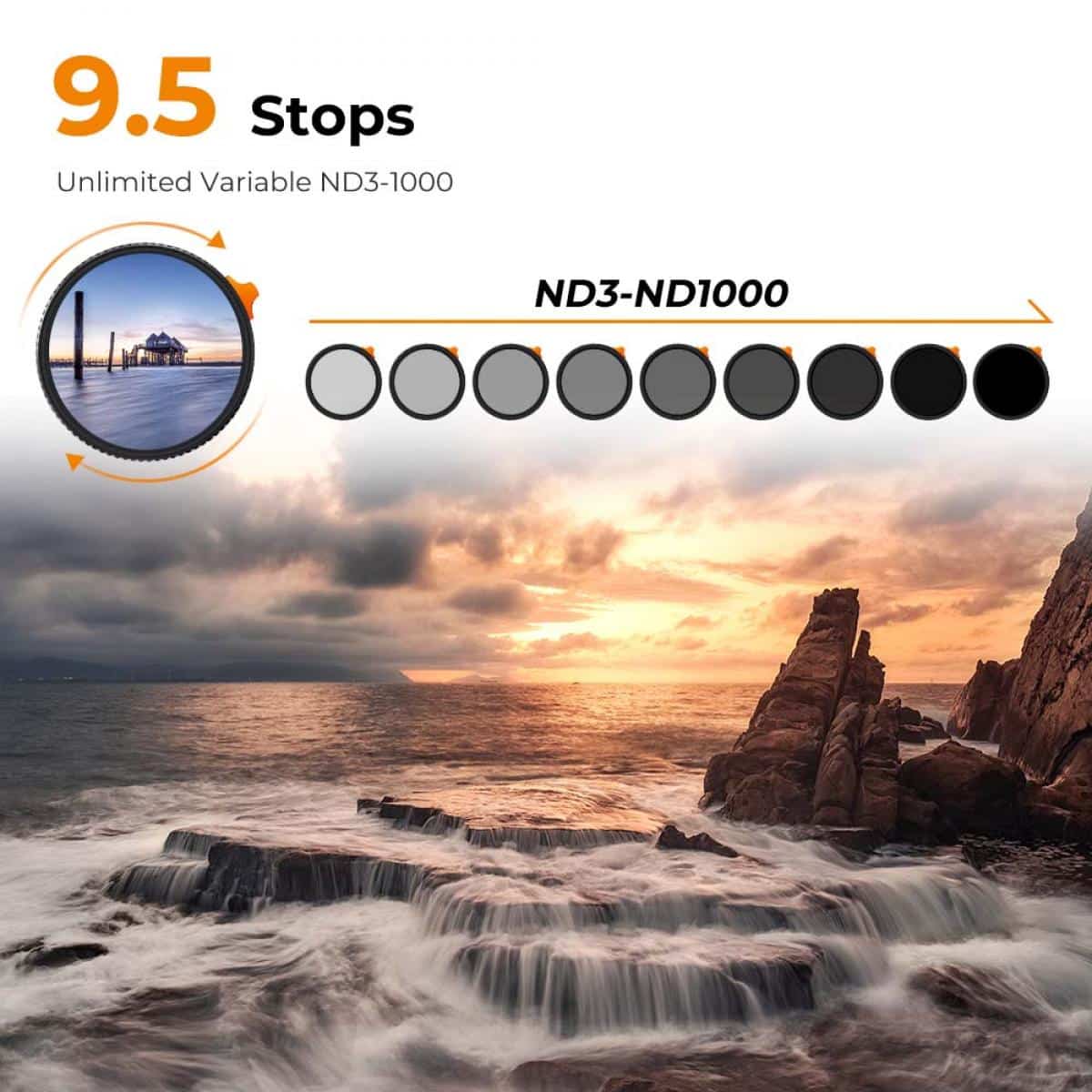
Variable neutral density filters exist to eliminate the workflow friction of swapping fixed-density filters mid-shoot. This filter delivers that utility across a genuinely usable span: ND3 at the low end cuts 1.5 stops, enough to open up one aperture stop in moderate overcast without clipping highlights. ND1000 at the high end blocks 10 stops, which turns a 1/250s exposure into a 4-second exposure under the same light, long enough to render moving water as smooth texture or empty a busy street of transient figures. The rotational mechanism between those endpoints is smooth and stepless, so you dial in the exact density the shot requires without hunting for a detent or fighting stiff threads. An orange aluminium finger tab on the outer ring provides tactile grip even with gloves on, a detail that matters when you're adjusting exposure on a tripod in cold conditions or trying to fine-tune density while monitoring a live view screen. Most variable ND filters force you to pinch a narrow front element; this tab gives you mechanical advantage and control.
The rotation range is calibrated to avoid the cross-polarisation artefact that appears when two linear polarisers overlap beyond their useful range. Push a typical variable ND past its maximum rated density and you'll see a dark X pattern across the frame. This filter's mechanical stops are set so that rotating to the ND1000 position keeps you inside the clean zone, meaning you can use the full 10-stop range without introducing optical defects. That's the difference between a filter you trust at every setting and one you only use in the middle of its range.
Optical Construction Built Around Image Integrity
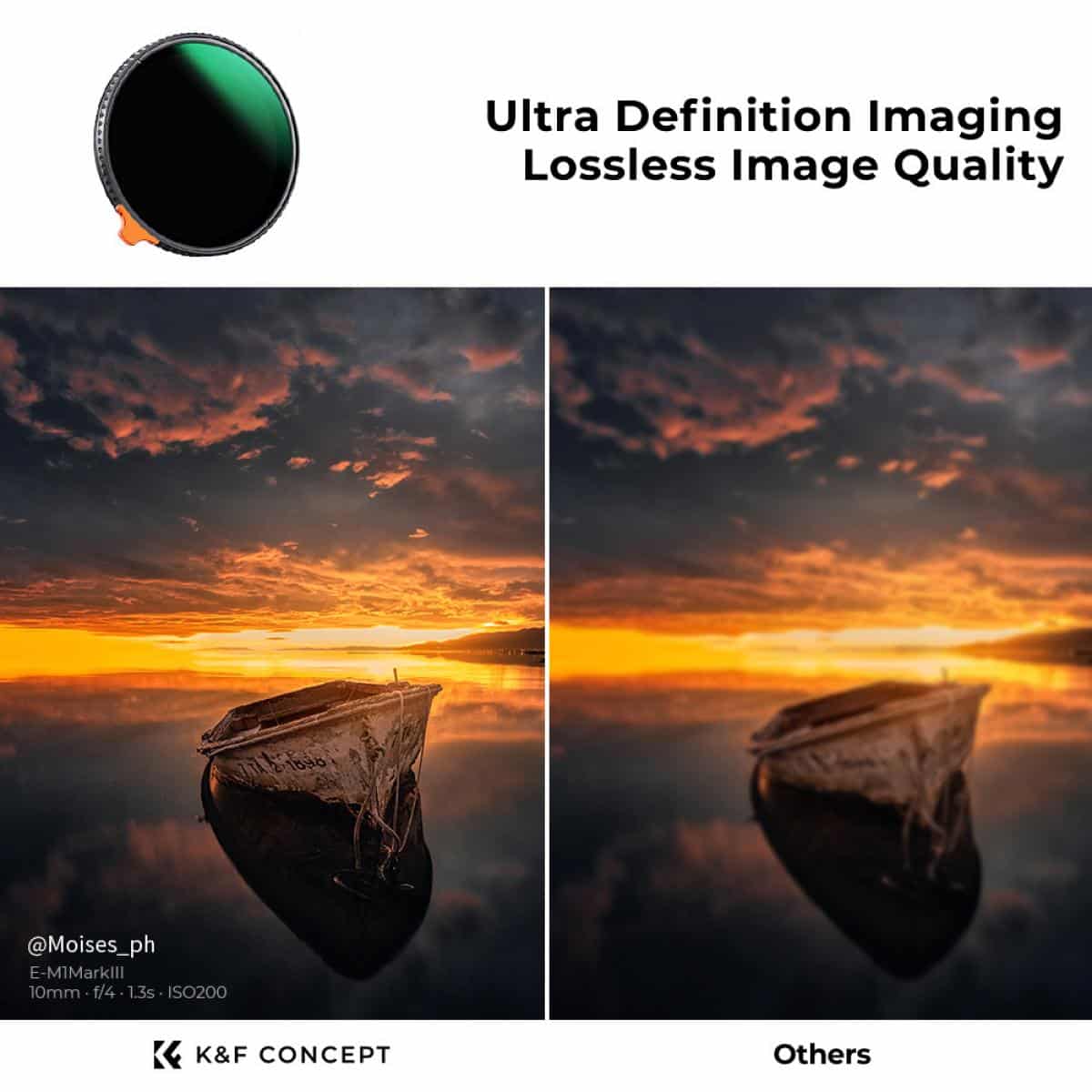
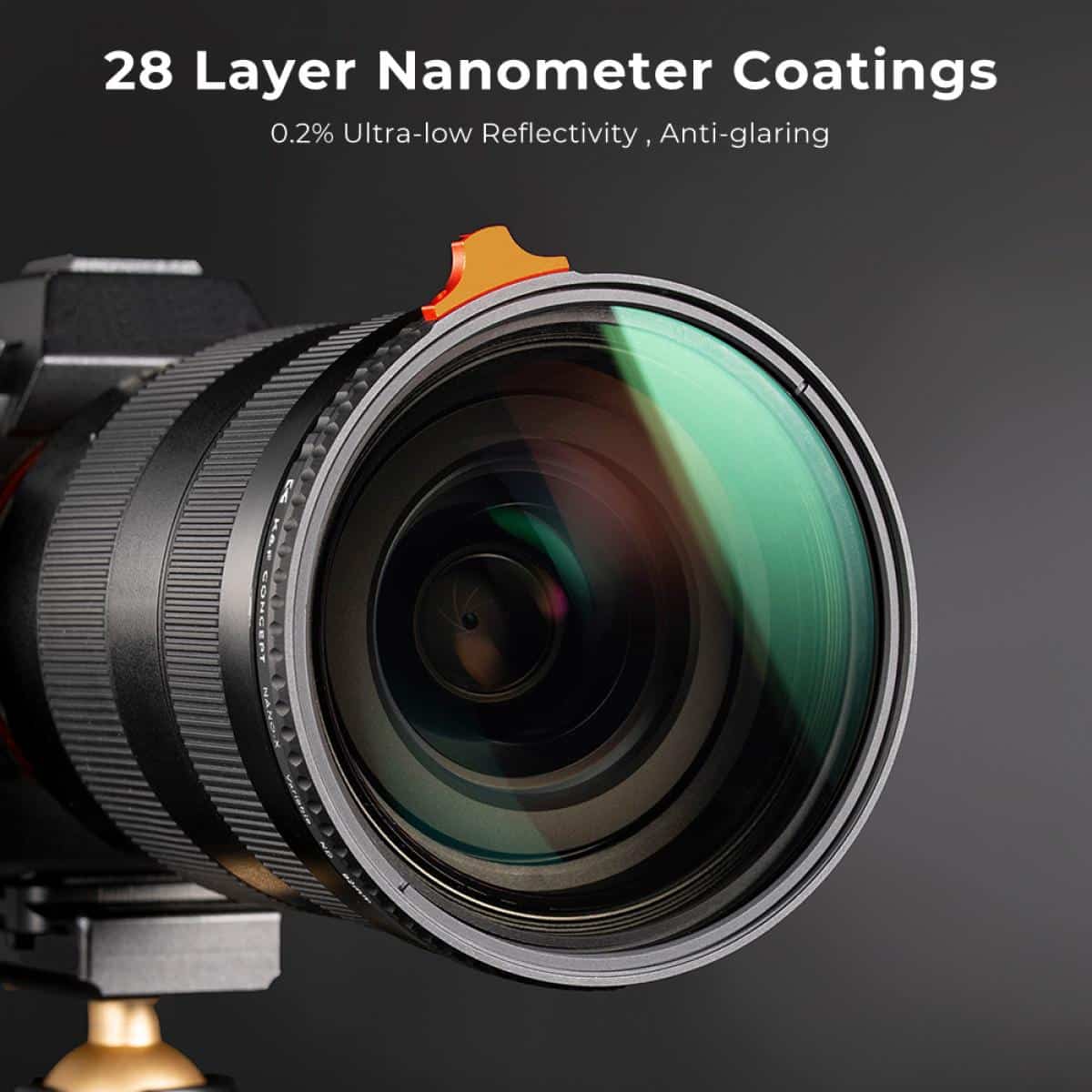
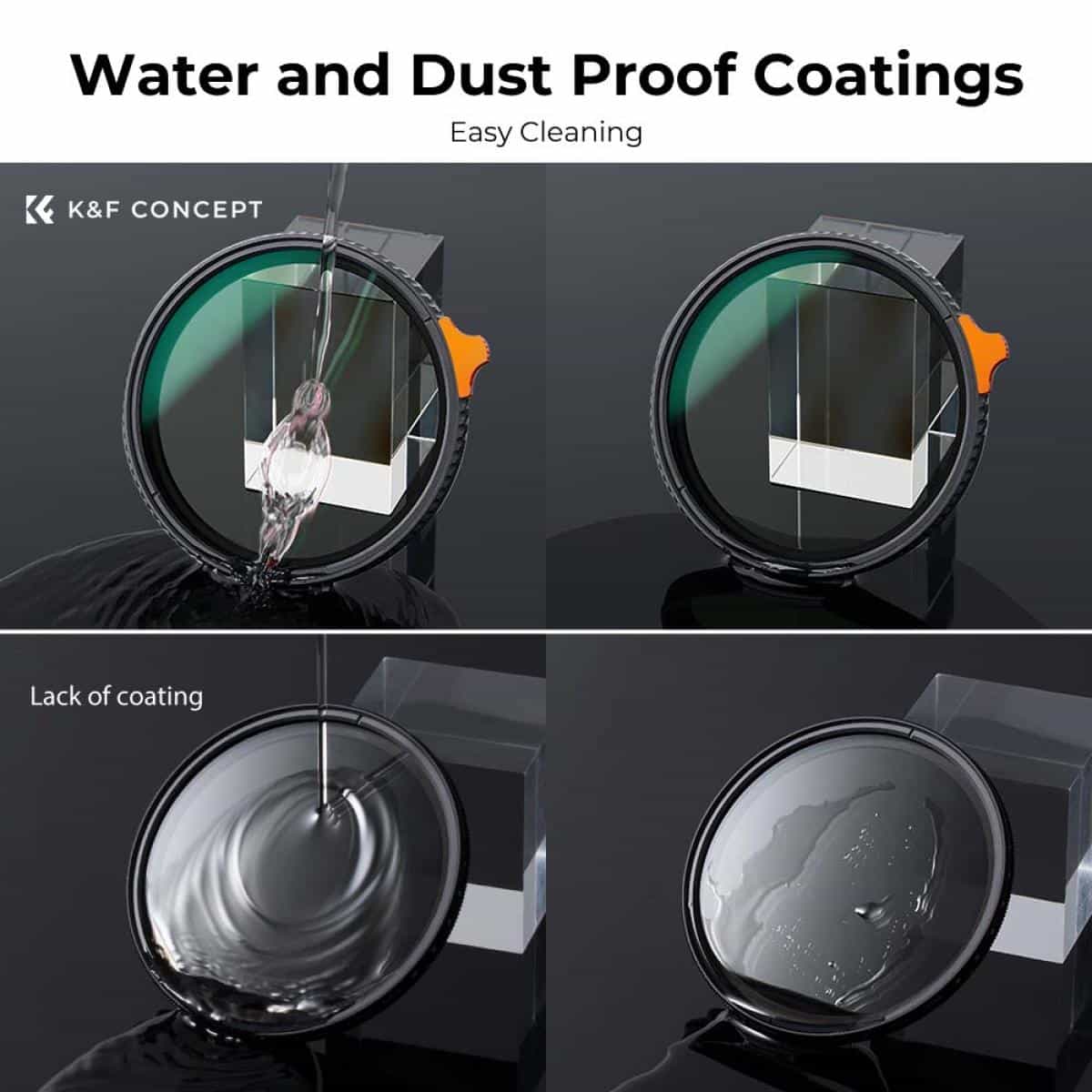
The filter element is Japanese optical glass, not resin or lower-grade material. That matters because glass holds its optical properties across temperature swings and doesn't flex under the clamping force of the filter threads, both of which preserve edge-to-edge sharpness. The glass receives a double-sided 28-layer nano coating, which serves three functions. First, it suppresses internal reflections that would otherwise reduce contrast when shooting into or near the sun. Second, the hydrophobic and oleophobic surface treatment causes water to bead and roll off rather than spreading into a film, and lets fingerprints wipe away with a single pass of a microfibre cloth instead of smearing. Third, the coating reduces the colour cast that afflicts cheaper variable ND filters, particularly at higher densities where stacked polarisers can introduce a magenta or cyan shift. You'll still want to check your white balance when you move from ND3 to ND1000, but the shift is minimal and correctable in post without degrading the file.
The frame is machined from aerospace-grade aluminium alloy, chosen for its combination of rigidity and light weight. A thin-walled frame reduces the risk of vignetting on wide-angle lenses, but only if the material is stiff enough not to deform under thread tension. Aluminium alloy meets that requirement at 61 grams, light enough that it doesn't shift the balance point of a lens when mounted. The frame's 9-millimetre profile is the thinnest you can achieve while still housing the dual polariser assembly and maintaining structural integrity. On a 16-millimetre full-frame lens or a 10-millimetre APS-C ultra-wide, that thin profile keeps the filter's front edge out of the image circle's periphery, so corners stay clear.
Practical Integration Into Shooting Workflows
Variable ND filters collapse a multi-filter kit into a single optic, which matters most when you're working in changing light or moving between setups. A timelapse sequence that spans sunrise will see the scene brightness increase by 8 to 10 stops over 30 minutes. With fixed ND filters, you'd need to pause the sequence, swap filters, and restart, introducing a discontinuity in the footage. With a variable ND, you rotate the filter in real time as the light builds, maintaining a consistent exposure across the entire sequence. The same logic applies to run-and-gun video work where you're moving between shaded and sunlit areas without time to stop and reconfigure your kit. Dial the density up as you step into the sun, dial it back down as you move into shade, and your footage holds a consistent exposure and motion cadence.
For stills work, the filter's utility centres on long-exposure daylight photography and wide-aperture shooting in bright conditions. A 10-stop reduction turns a midday beach scene into a 20-second exposure at f/8, long enough to blur wave motion into mist and remove people from the frame. A 3-stop reduction lets you shoot a portrait at f/1.4in open shade without overexposing, so you retain the shallow depth of field that isolates the subject. Both scenarios are technically achievable with fixed ND filters, but the variable filter lets you fine-tune the exposure in half-stop increments by rotating the ring while watching the exposure meter, faster and more precise than swapping filters and checking again.
The filter threads onto your lens in the standard manner: align the threads, rotate clockwise until snug, then back off a quarter turn to avoid cross-threading. The aluminium threads are cut with enough tolerance that they won't bind on brass or aluminium lens barrels, but tight enough that the filter won't unscrew itself during transport. Once mounted, the filter adds 9 millimetres to the front of your lens, which may affect lens cap fit depending on the cap design. Most pinch-style caps will still attach over the filter; snap-on caps typically won't. The included leatherette protective pouch has a pull-tab ejector at the base, so you can push the filter out from below rather than pinching it from above, reducing the risk of fingerprints on the glass when you're retrieving it from the pouch in the field.
Size Selection and Compatibility
The filter is available in thread diameters from 49 millimetres to 82 millimetres, covering the majority of interchangeable-lens camera systems. Your lens barrel will have its filter thread diameter marked near the front element, usually as a number preceded by the diameter symbol: ø58, ø67, ø77, etc. Match that number to the filter size. If you shoot with multiple lenses of different filter diameters, you can use step-up rings to mount a larger filter on a smaller lens, but you cannot step down without vignetting. The most efficient approach is to buy the filter in the diameter of your largest lens and use step-up rings for the smaller ones, so you're only carrying one variable ND.
The 9-millimetre profile is thin enough that you can stack a circular polariser in front of the variable ND if you need both polarisation and density control, though stacking two filters increases the risk of vignetting on lenses wider than 24 millimetres full-frame equivalent. If you're shooting ultra-wide and need both effects, test for vignetting at your widest focal length and smallest aperture before committing to the stack in a critical shoot.
Field Durability and Maintenance
The nano coating's hydrophobic properties are most noticeable in wet conditions: rain, sea spray, or mist. Water droplets sit on the surface as beads rather than spreading into a film, so they don't obstruct the image and they're easy to shake or wipe off. The oleophobic treatment does the same for oils, which means fingerprints from handling the filter don't bond to the glass. A dry microfibre cloth will lift them without leaving residue. If you're shooting in dusty or sandy environments, the coating won't prevent particles from landing on the filter, but it does make them easier to remove without scratching the glass, because they don't adhere as strongly to the coated surface.
The aluminium frame resists corrosion in humid or salty environments better than brass, though you should still rinse the filter with fresh water after shooting near the ocean to prevent salt buildup in the threads. The black anodised finish is durable enough to withstand repeated mounting and dismounting without flaking, but it will show wear over time if you're frequently threading and unthreading the filter. That wear is cosmetic and doesn't affect optical performance.
What the Filter Does Not Do
A variable ND filter is not a substitute for a graduated ND filter. It reduces light uniformly across the frame, so it won't balance a bright sky against a darker foreground. If you're shooting landscapes with a significant brightness range between sky and land, you'll still need a grad ND or exposure blending in post. The filter also doesn't eliminate the need for a circular polariser in situations where you want to control reflections or enhance sky saturation. You can stack a polariser with the variable ND, but the variable ND alone won't give you polarisation effects.
At maximum density, a 10-stop reduction requires a shutter speed slow enough that camera shake becomes a factor. You'll need a tripod for exposures longer than 1/60s on most systems, and a remote shutter release or self-timer to avoid introducing vibration when you press the shutter button. The filter doesn't stabilise the image; it just gives you the exposure latitude to use long shutter speeds in bright light.
Why This Filter Exists in the K&F Concept Range
K&F Concept's product development starts with identifying workflow friction points that force photographers to choose between technical compromise and operational complexity. Variable ND filters address the friction of carrying and swapping multiple fixed-density filters, but only if the variable filter itself doesn't introduce new problems: colour casts, cross-polarisation artefacts, or vignetting. This filter's design prioritises eliminating those failure modes, so the tool solves the original problem without creating secondary ones. The 28-layer nano coating, the thin frame profile, and the mechanical stops that prevent over-rotation are all responses to known variable ND failure points. The result is a filter you can use across its full density range without second-guessing whether the image quality will hold up.
The 12-month limited warranty covers manufacturing defects, which in practice means frame deformation, coating delamination, or thread failure. It doesn't cover scratches, cracks, or damage from improper handling, so treat the filter as you would any precision optic: store it in the protective pouch when not in use, avoid setting it down glass-first on hard surfaces, and don't over-tighten the threads when mounting it. The filter is a tool, not a consumable, and with reasonable care it will outlast the camera body you're using it on.
The K&F Concept Nano-Xcel Variable ND Filter is available now as SKU KF01.2004-2012, shipped locally with the protective pouch and backed by the standard K&F Concept support terms.