


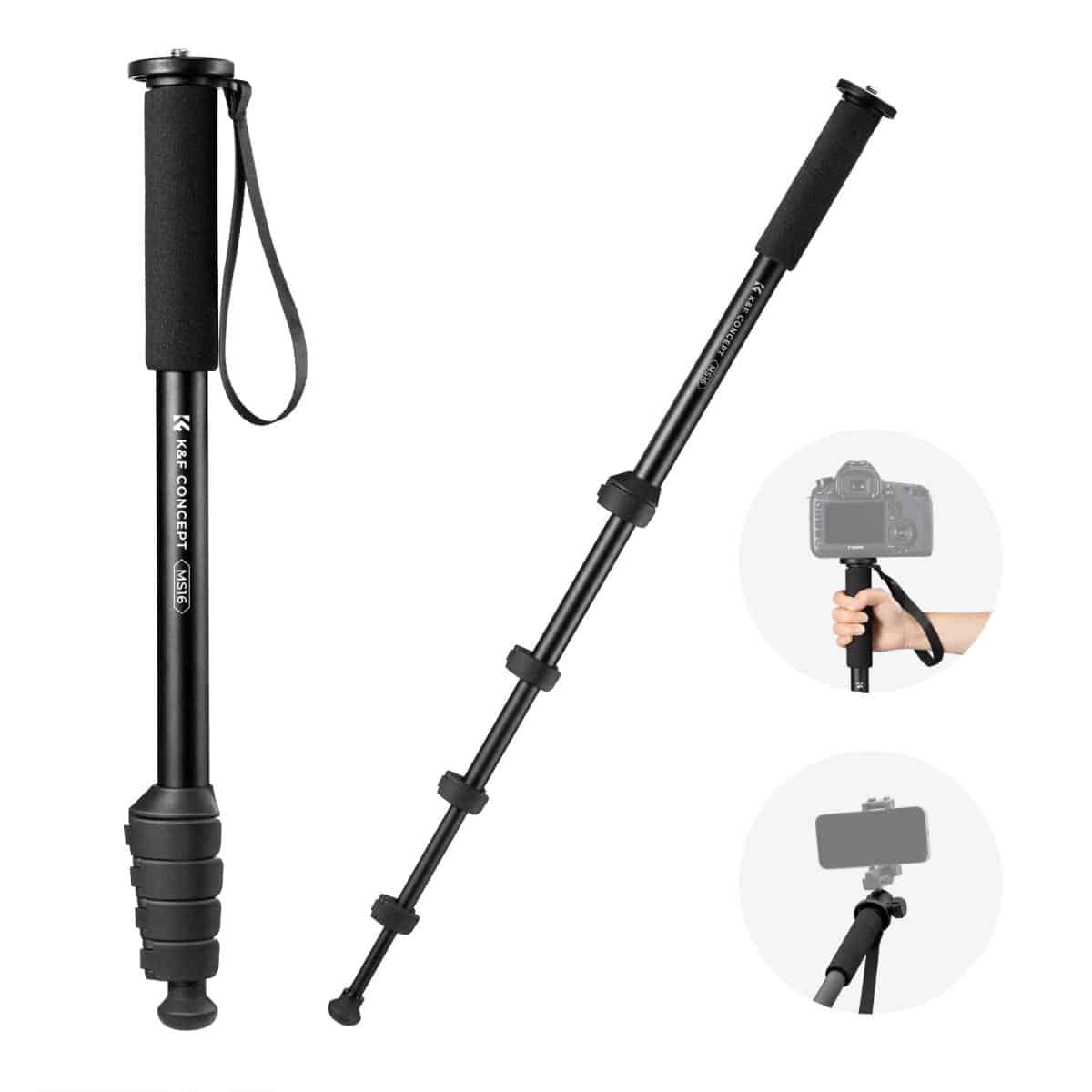

K&F Classic Monopod for stability without sacrificing portability
Single-leg support built for photographers who need stable framing without the setup time or bulk of a tripod. This aluminium pole extends to 160cm when you need reach, collapses to 43cm when you need to move fast, and holds 10kg of camera and lens without wobble. Five leg sections lock independently so you can dial in exactly the height a composition demands, whether that's eye-level for a standing portrait or waist-high for a low-angle architectural detail. The collapsed length fits inside a daypack or straps to the side of a camera bag, which matters when you're hiking to a location or working a multi-stop event shoot where every kilogram counts.
Terrain Adaptation Without Accessory Swaps
The foot assembly handles surface changes without forcing you to carry extra parts. A removable rubber cap covers a metal spike. On hard indoor floors, tile, or paved surfaces, the rubber stays on and grips without scratching or sliding. On soft ground, grass, mud, or loose gravel, pull the rubber cap off and the exposed spike digs in for purchase that a flat foot cannot achieve. This dual-mode design eliminates the need to pack separate feet for different locations. If your shoot moves from a polished gallery floor to wet parkland in the same afternoon, the monopod adapts in seconds. The spike holds firm on uneven terrain where a rubber nub would slip, and the rubber prevents the clatter and floor damage that a bare spike would cause indoors.
Grip Security in Adverse Conditions
Foam padding wraps the upper shaft where your hand naturally rests during setup and repositioning. The padding remains tacky when wet, which prevents the pole from rotating in your grip if you're shooting in drizzle or if your palms are sweating during a long outdoor session. A wrist strap threads through the foam section and loops around your hand, adding a fail-safe if the monopod tips or if you need to let go momentarily to adjust a camera setting. The strap keeps the pole tethered so it cannot fall and damage the mounted gear. Together, the foam and strap reduce the cognitive load of worrying about grip security, letting you concentrate on framing and timing instead of whether the support is about to slip out of your hand.
Height Adjustment Speed
Each of the five leg sections locks with a flip-lever mechanism. Flip all five levers open, extend the pole to the height you need, flip the levers closed, and the monopod is locked. The process takes seconds, which matters when light is changing or when a subject is moving and you need to reposition quickly. The levers provide tactile feedback so you know by feel when a section is fully locked, even if you are looking through the viewfinder rather than down at the pole. Once locked, the sections do not creep or sag under load. A 10kg camera and telephoto lens combination stays at the height you set, shot after shot, without requiring you to re-tighten mid-session. The locking force is high enough to prevent drift but low enough that you can operate the levers with cold fingers or while wearing thin gloves.
Load Capacity for Professional Rigs
The 10kg capacity accommodates a full-frame DSLR or mirrorless body with an attached 70-200mm f/2.8 lens, or a cinema camera with a compact rig. This headroom means the monopod does not flex or sway when you pan to follow a moving subject or when you press the shutter and introduce a small downward force. Stability under load translates directly to sharper images at slower shutter speeds, because the pole absorbs small vibrations rather than transmitting them to the camera. If you shoot video, the rigidity prevents the micro-wobbles that make handheld footage look amateurish. The monopod holds the camera steady enough that you can use it as a pivot point for smooth horizontal pans, achieving a controlled motion that a handheld grip cannot match.
Dual Mounting Interface
The top plate exposes both a 1/4-inch thread and a 3/8-inch thread. The 1/4-inch thread accepts standard camera quick-release plates, ball heads, and most consumer tripod heads. The 3/8-inch thread fits professional fluid heads, heavy-duty ball heads, and video rigs that require a larger thread for stability. You do not need an adapter bushing or a separate plate to switch between the two standards. Unscrew the top plate, flip it over, and the opposite thread is ready to use. This dual interface eliminates the frustration of arriving at a location and discovering that your head does not match the monopod thread. It also future-proofs the pole: if you upgrade from a lightweight mirrorless setup to a heavier video rig, the monopod continues to work without modification.
Portability for Multi-Location Shoots
At 43cm collapsed, the monopod fits vertically inside a rolling camera case, horizontally across the top of a backpack, or strapped to the outside of a messenger bag. The compact pack size means it does not force you to choose between bringing the monopod and bringing another lens or lighting modifier. If you are travelling by air, the collapsed length stays within carry-on dimension limits for most airlines, so the monopod remains with you rather than being checked. The aluminium construction keeps the weight low enough that carrying the monopod for several hours does not cause shoulder fatigue, yet the material is rigid enough that the pole does not bend under the rated load. For event photographers moving between ceremony, reception, and portrait locations, or for travel photographers covering multiple sites in a day, the collapsed size and weight make the monopod a practical addition to the kit rather than a burden.
Use Case Clarity
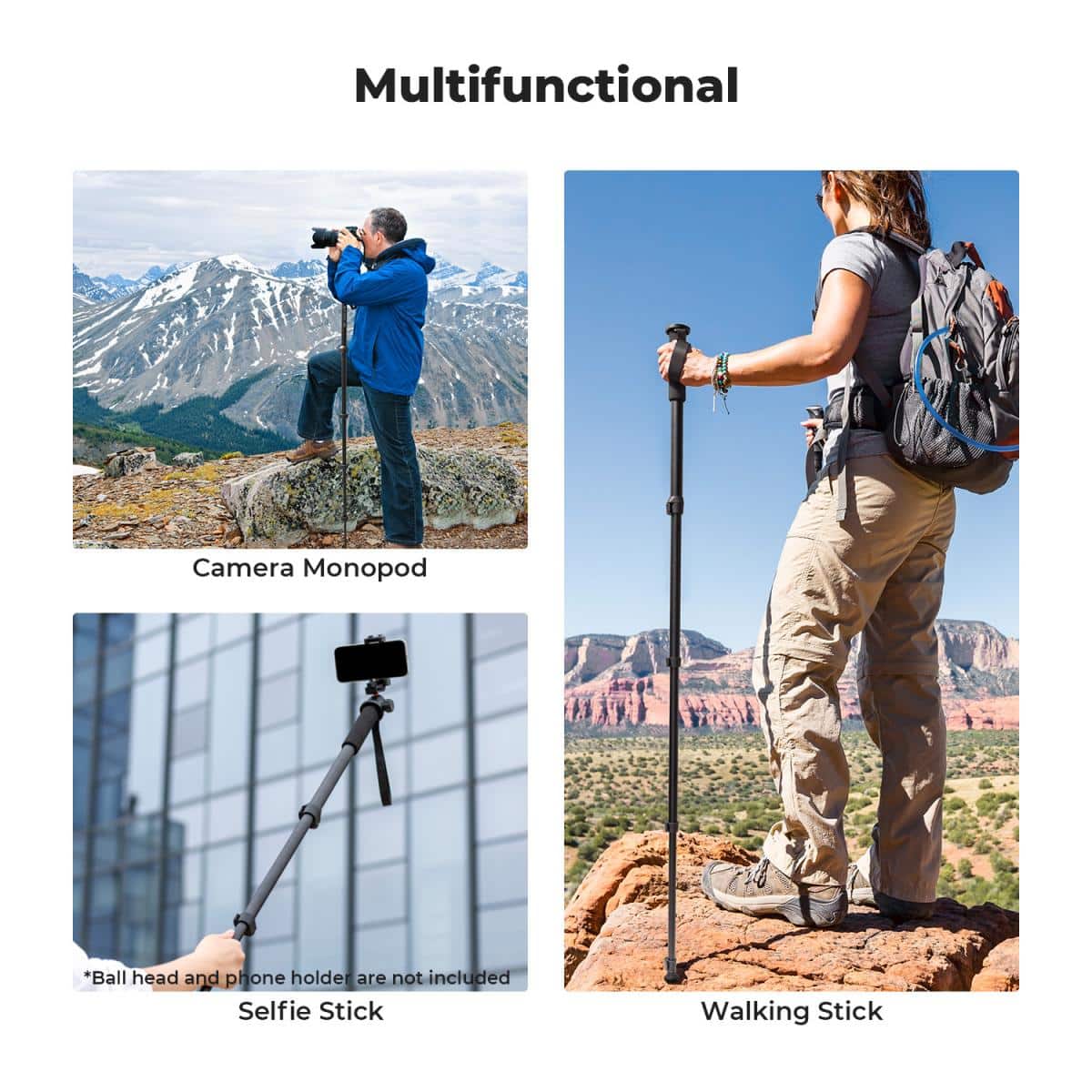
This is not a tripod substitute for long-exposure night photography or for any situation where the camera must remain completely motionless without operator input. A monopod requires you to hold it and provide lateral stability; it prevents vertical sag and absorbs high-frequency shake, but it does not stand on its own. The trade-off is speed and mobility. You can move from one shooting position to another in seconds, set up in spaces too narrow for a tripod's footprint, and shoot in crowds without the risk of someone tripping over splayed legs. The monopod excels in scenarios where you need repeatable framing and shake reduction but cannot afford the time or space cost of a three-legged support. Sports, wildlife, event coverage, and run-and-gun video are the natural applications. For static compositions where you can take your time, a tripod remains the better tool. For everything else, this pole delivers the stability you need without the setup friction you do not.
Field Durability
Aluminium construction resists corrosion from rain, salt spray, and humidity better than steel, and it does not crack in cold temperatures the way some composite materials can. The flip-lever locks are metal, not plastic, so they do not strip or shear under repeated use. The foam grip does not degrade in UV exposure or become sticky in heat. These are not premium features; they are baseline requirements for gear that will be used outdoors in variable conditions over multiple seasons. The monopod is built to survive being knocked over, dropped into a camera bag without a protective case, and used in environments where dust, moisture, and temperature swings are routine. It will not fail in the field because a plastic component fatigued or because a seal let moisture into a joint. The design is simple, mechanical, and repairable if something does eventually wear out.
This aluminium monopod solves the portability-versus-stability problem for photographers who shoot in multiple locations and cannot carry a full tripod. It extends high enough for standing eye-level work, collapses small enough to travel easily, locks fast enough to keep pace with changing scenes, and holds heavy enough gear to support professional camera systems. The dual-foot design and dual-thread interface eliminate the need for accessory kits, and the foam grip and wrist strap keep the pole secure in your hand regardless of weather. If your shooting style involves movement, if your locations vary, and if you need stable framing without the bulk and setup time of a tripod, this pole is the tool that bridges the gap. KF09.138V1.