




K&F Alpha-Air-Shooter Premium Designer Camera Backpack
The K&F Concept Alpha-Air-Shooter is a 25-litre photographer's backpack built around a crush-resistant internal wire frame and finished with custom aluminium hardware. Available in black, yellow or grey, it carries two camera bodies, four lenses, a 15.6-inch laptop, a 12.9-inch tablet and field accessories while maintaining a narrow profile that doesn't telegraph "expensive gear inside" on public transport or at event venues.
Protection Architecture
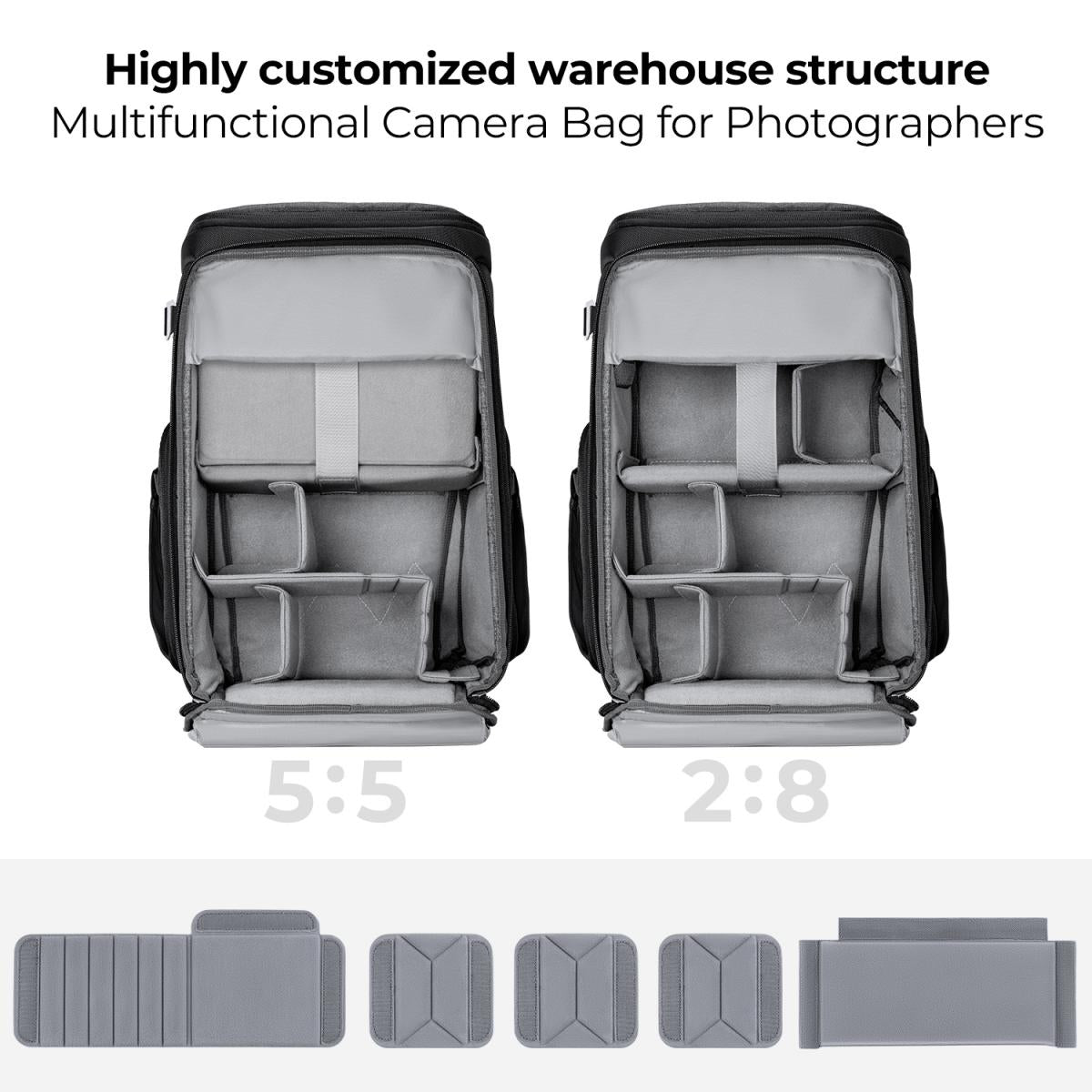
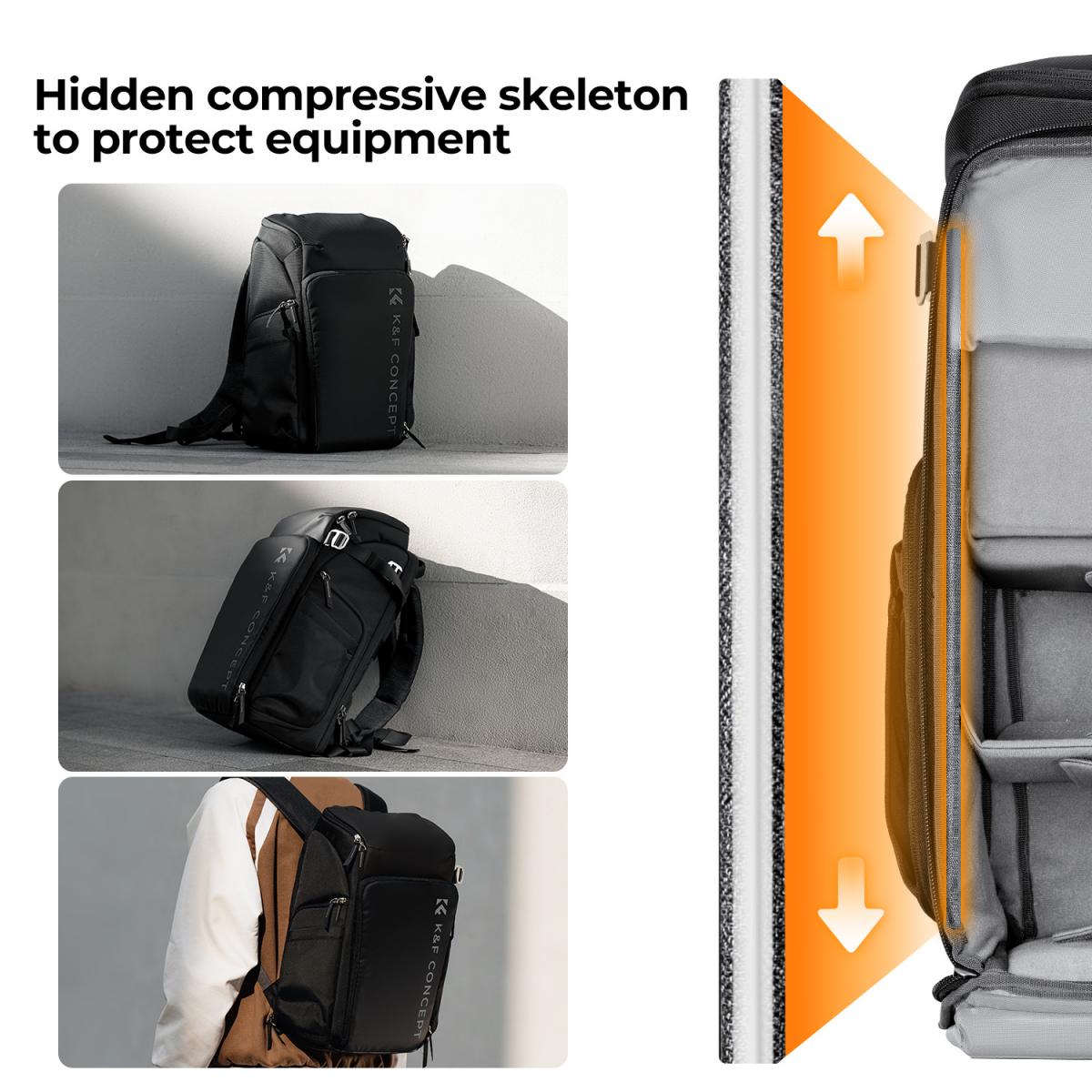
The bag's structure centres on a discreet hard-wire frame embedded in the walls. This frame distributes impact forces away from the main compartment when the bag is dropped or compressed under airline overhead bins. Compartment dividers are firm-pressed foam rather than floppy inserts, so they hold position under load and don't collapse when you pull a lens out mid-shoot. High-grade Velcro on the dividers maintains grip through repeated repositioning; the operator has tested bags where cheap hook-and-loop fails after six months of field use, leaving dividers sliding loose inside the bag. The Alpha-Air-Shooter avoids that failure mode.
All zippers run behind a nylon lip that seals when closed, blocking fine rain and dust ingress at the closure line. A stowable rain cover deploys from a base pouch for heavier weather. The padded back panel doubles as the laptop compartment's rear wall, so your computer sits between two layers of foam rather than against a single fabric skin.
Compartment Layout and Access Strategy
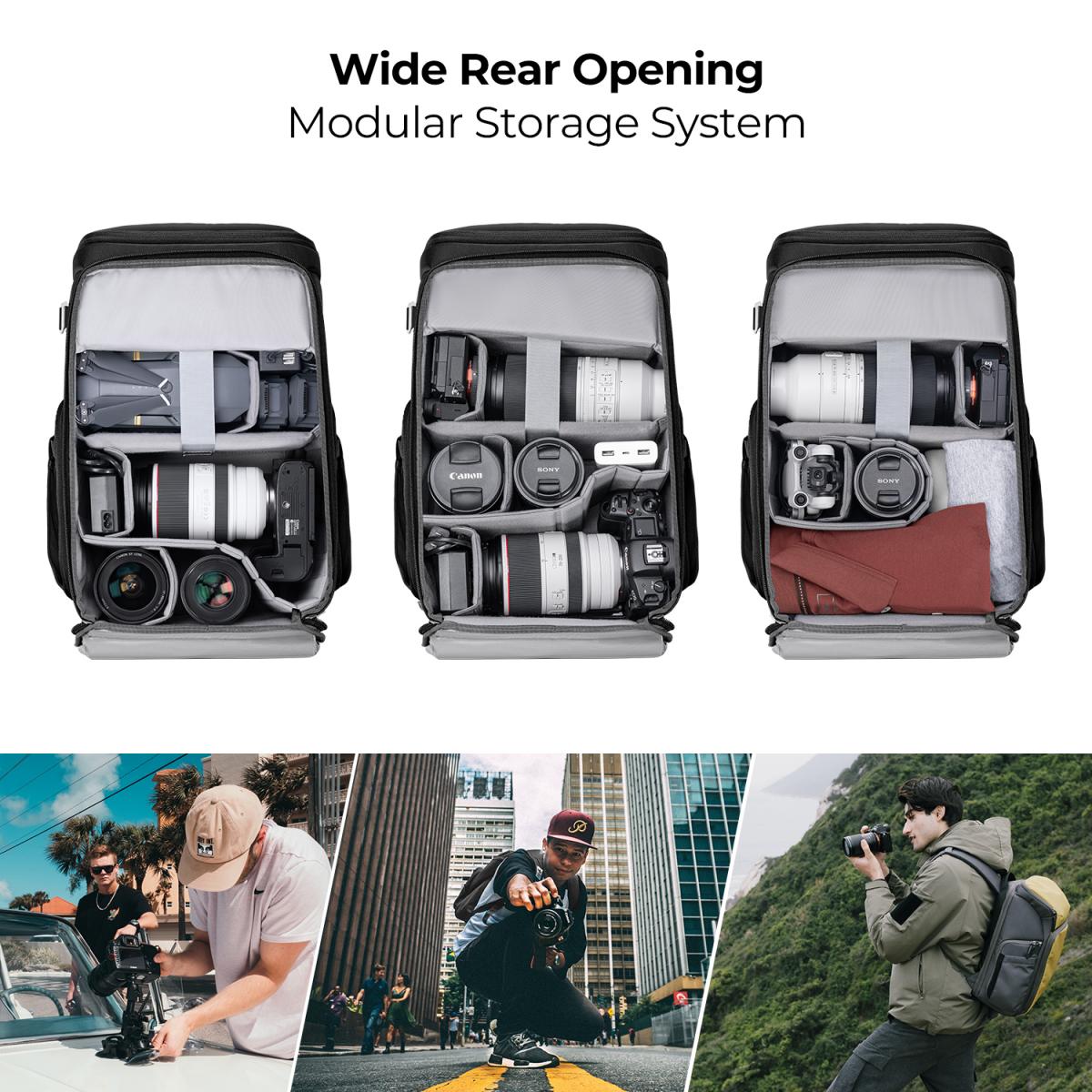
The main camera compartment opens via three independent zippers. The back panel unzips fully to expose the entire interior when the bag is laid face-down,the fastest way to repack between locations. A top-access zipper reaches the upper half of the compartment without exposing lower gear, useful when the bag is upright on a venue floor and you need to swap a body or prime. A side-access zipper targets the middle section for lens changes on the move; this port also functions as an elasticated bottle holder when not in use as a gear hatch.
An optional horizontal divider splits the main compartment into upper and lower zones. With the divider in place, the top and side zippers access the upper zone independently, while the back-panel zipper reaches both. This separation is practical when you're carrying a drone kit or clothing in the upper section and want to access camera gear below without disturbing what's on top. Remove the divider and the compartment becomes a single 25-litre volume.
The laptop sleeve sits against the back panel, accessible through a dedicated rear zipper separate from the main compartment. This placement keeps the laptop's weight close to your spine and allows you to pull the computer at airport security without opening the camera section. The sleeve accommodates a 15.6-inch laptop or 12.9-inch tablet with front and rear padding.
Front Expansion Compartment
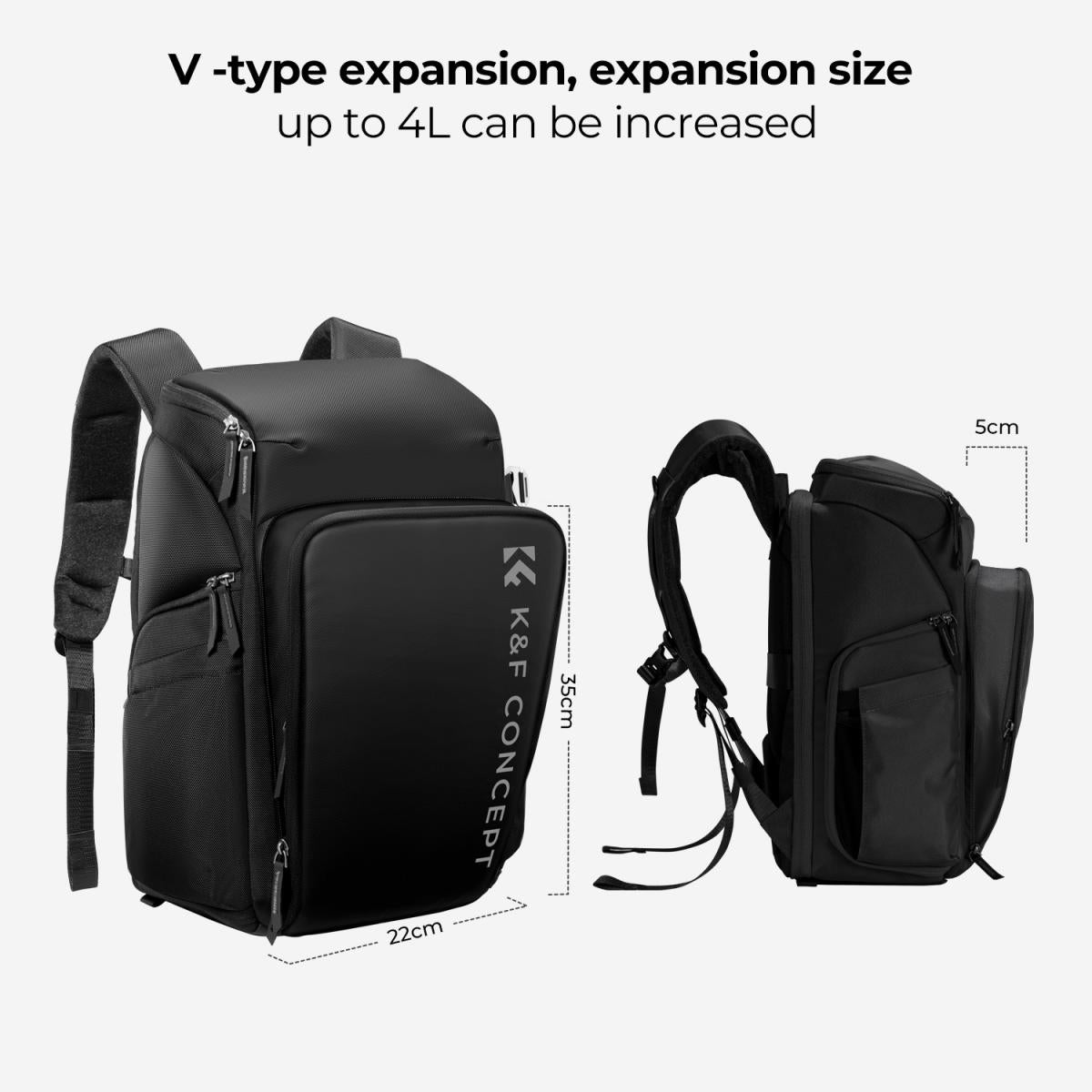
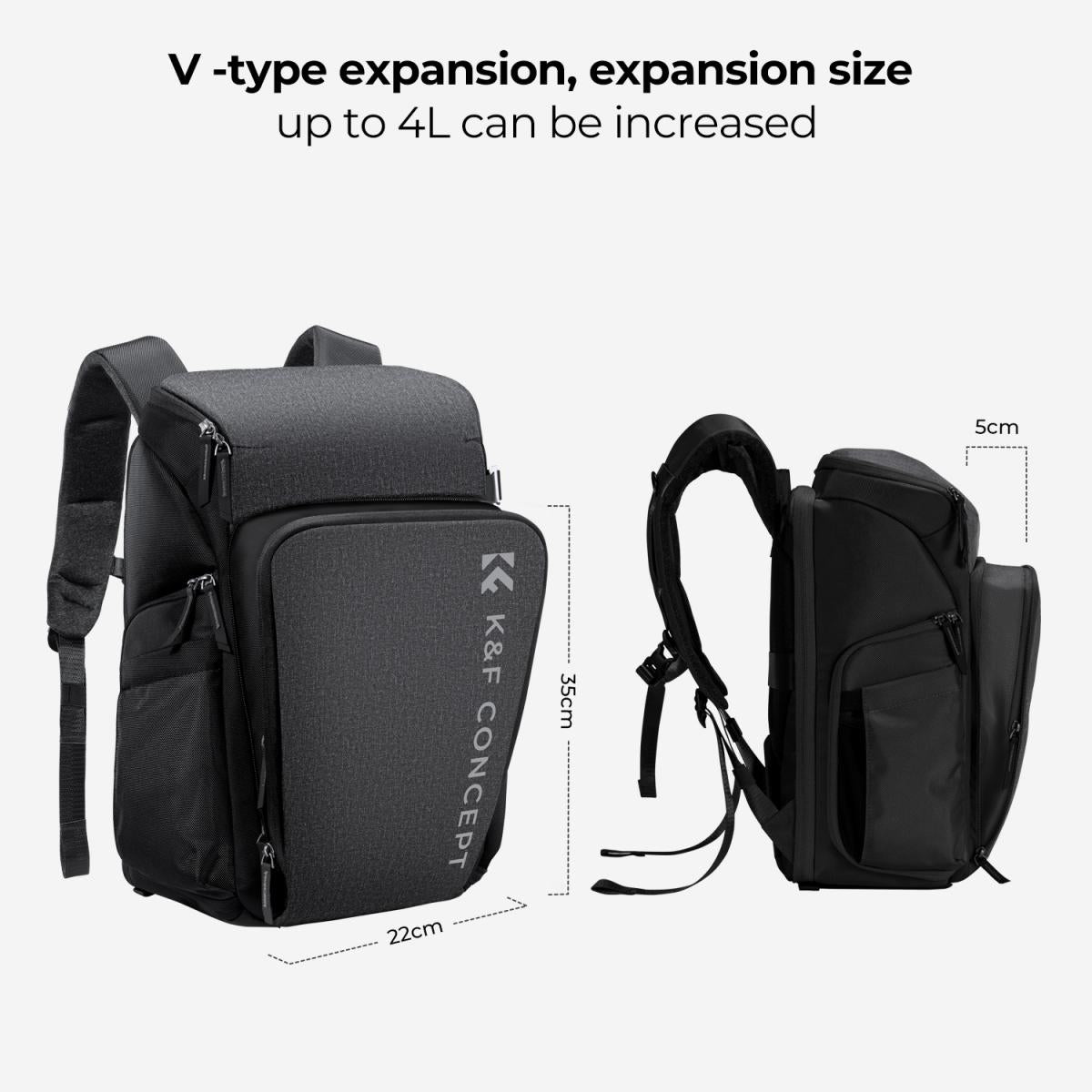
The front pocket is a bellows design that expands outward when loaded. Unloaded, it sits flat; packed with a tablet, documents and a lens cloth, it extends to roughly double its collapsed depth. Internal fabric pockets organise memory cards, batteries, cables and a phone. An elastic retention strap crosses the interior to secure contents during transit. A detachable keychain clips inside for key security in crowded environments.
Side and Auxiliary Storage
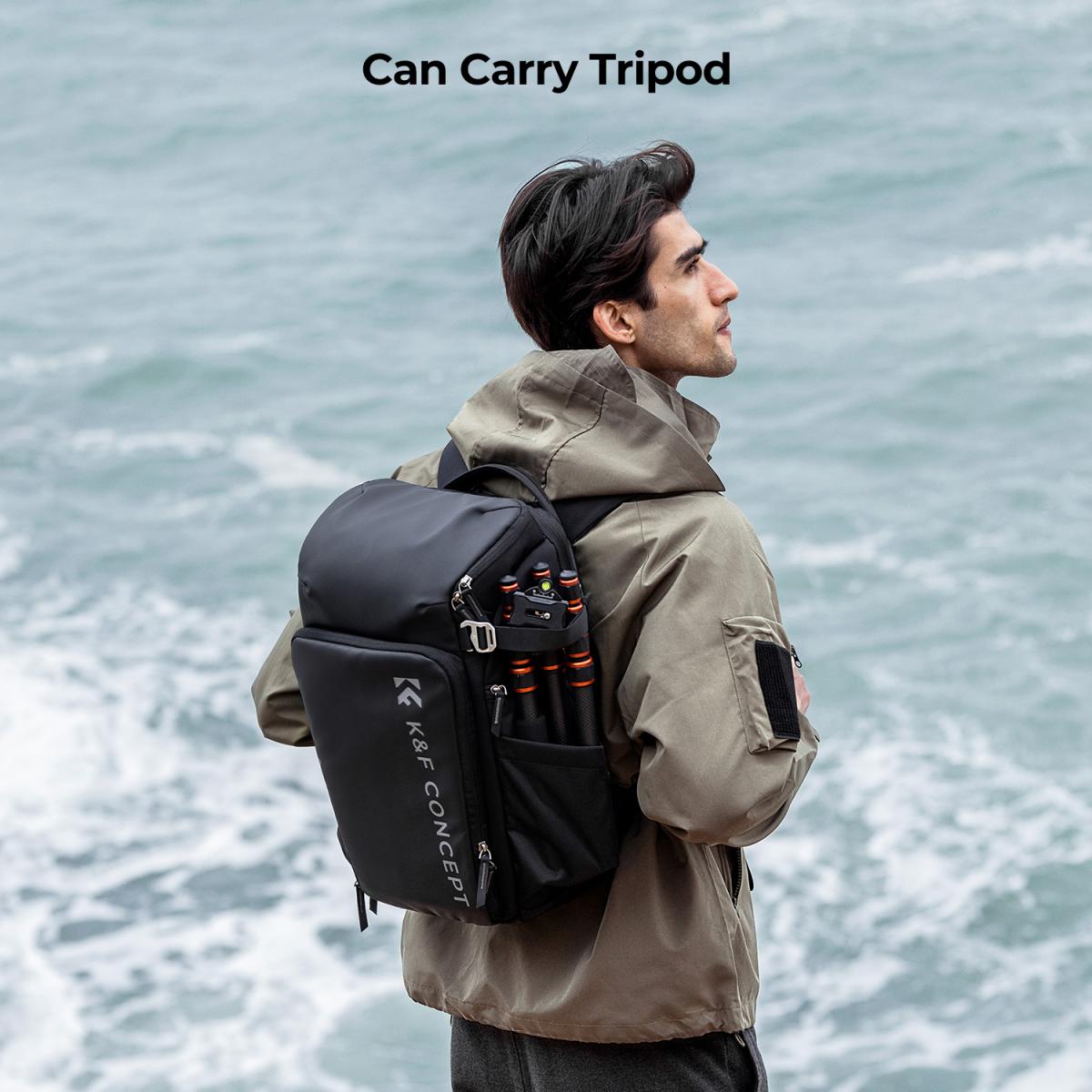
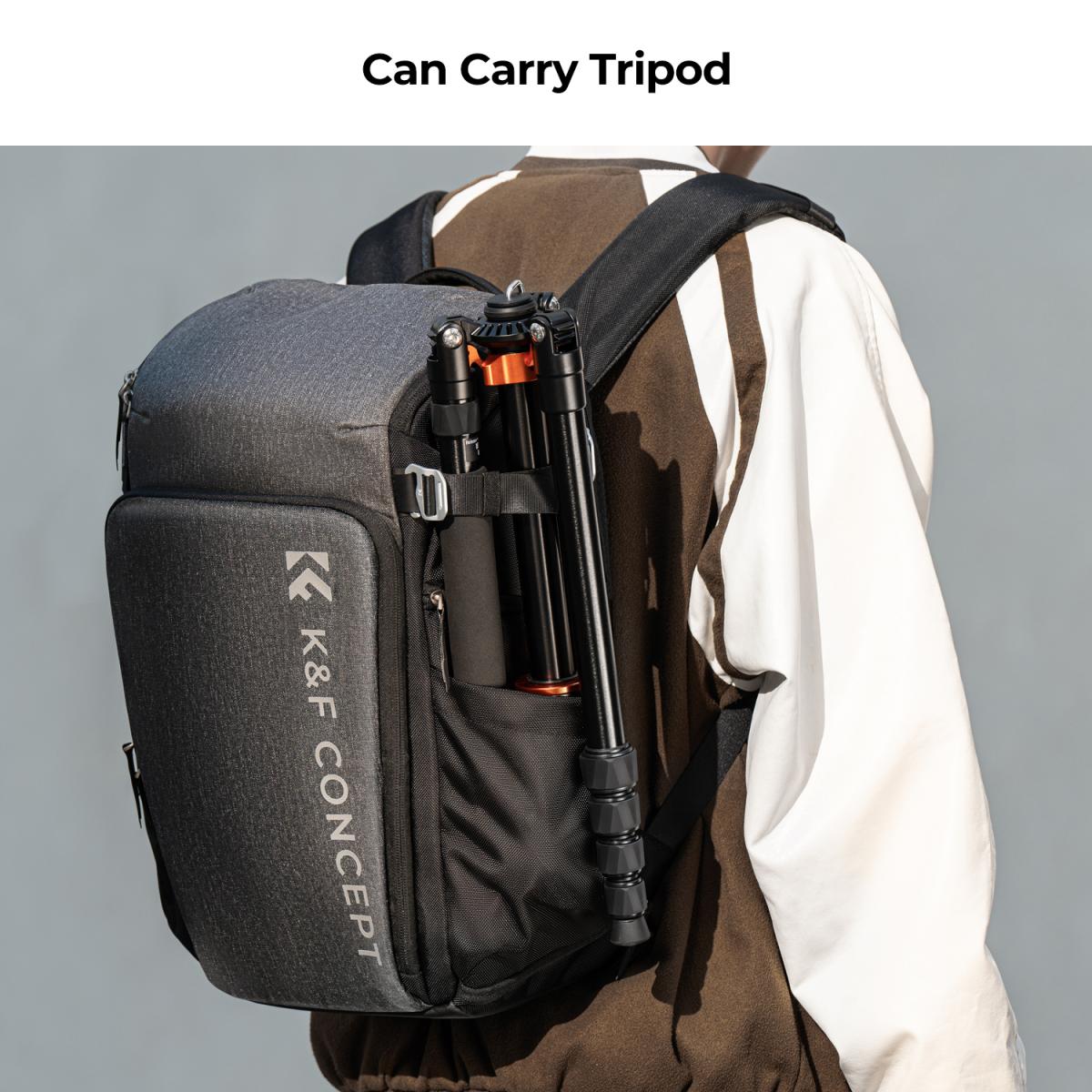
The left side of the bag features a zippered pocket with internal elasticated mesh dividers for small accessories,spare batteries, SD card wallets, a power bank, car keys. An external adjustable strap on this side secures a compact tripod vertically; tripod feet slot into a base pouch to prevent the legs swinging loose. When no tripod is attached, the pouch holds a second water bottle.
The right side hosts the side-access zipper and bottle holder described earlier. Both side pockets include mesh pouches on their inner faces for items you want separated from the main compartment but still quickly accessible.
Carry System and Load Distribution
Shoulder straps and back panel use anti-sweat mesh over high-density foam. The back panel also incorporates a luggage pass-through strap that slides over a rolling suitcase handle, stabilising the backpack on top of wheeled luggage during airport transfers. A padded top handle provides a single-hand carry option for short moves between a vehicle and a shoot location.
An adjustable chest strap clips across the shoulder straps to transfer load from your shoulders to your sternum, reducing fatigue on longer walks or uneven ground. The strap is removable if you prefer an unobstructed chest for low-angle shooting positions where you're kneeling or lying prone.
Pack heavier items,camera bodies, telephoto zooms,low in the bag to keep the centre of gravity near your hips. This reduces the tendency for a loaded pack to pull backward at the shoulders. The firm dividers let you stack lenses vertically rather than nesting them, which keeps weight distribution predictable and prevents the bag sagging to one side.
Hardware and Fasteners
Buckles and clips are custom-milled aluminium rather than injection-moulded plastic. Aluminium buckles survive being stepped on or crushed in an overhead bin; plastic equivalents crack under the same load. Strap adjustment points use bar-tack stitching at stress zones,the points where shoulder straps attach to the bag body and where the chest strap anchors to the shoulder straps.
Zipper pulls are metal with a rubberised grip surface. The main compartment zippers are lockable via small loops that accept a padlock or cable tie, useful when the bag is checked as luggage or left in a hotel room.
Capacity in Real-World Terms
A typical load for a full-day editorial shoot: two mirrorless bodies (one with battery grip), a 24-70mm f/2.8, a 70-200mm f/2.8, a 16-35mm f/4, a 50mm f/1.8, a 15.6-inch laptop, a 12.9-inch tablet, three spare batteries, an SD card wallet, a lens cloth, a small LED panel, cables and a 750ml water bottle. That configuration leaves the front expansion pocket available for a rain jacket or client documents. Add a lightweight tripod strapped to the side and the bag is at working capacity without being overpacked.
For travel, the same compartment fits a camera body, three lenses, a laptop, a tablet, a wash kit in the front pocket and a change of clothes in the upper zone if you use the horizontal divider. The bag's 25-litre volume sits below most airline carry-on size limits, though always verify with your carrier.
Durability Considerations
The bag is backed by a one-year warranty covering manufacturing defects. Zippers, stitching and hardware are the common failure points in any camera bag; the Alpha-Air-Shooter addresses these with reinforced stitching at load-bearing seams, metal zipper pulls and aluminium buckles. The rain cover is a separate piece stored in its own pouch, so it doesn't degrade the main fabric when stowed wet.
Velcro on the dividers is a consumable component in any modular bag. High-grade hook-and-loop lasts longer, but all Velcro eventually loses grip with repeated use. The Alpha-Air-Shooter uses a denser weave than budget bags, extending useful life, but plan to replace dividers or re-Velcro them after several years of heavy use if you're reconfiguring the interior weekly.
The Alpha-Air-Shooter is a wire-framed, multi-access camera backpack for photographers who need a 25-litre capacity in a form that doesn't look like a camera bag from across a room. It prioritises structured protection, modular layout and carry comfort over minimal weight. If your shoots involve public transport, event venues or airline travel and you're carrying two bodies plus a set of zooms, this is the backpack that gets your gear there intact,KF13.128-128V4.