




K&F Spring Clip for Mounting Reflectors or an Umbrella
Studio efficiency hinges on how quickly you can position light modifiers exactly where they need to be, then lock them there without drift. The K&F Concept Reflector Spring Clip Mounting Bracket delivers that certainty through a combination of industrial-grade spring tension, multi-axis articulation, and universal attachment geometry. Built from black metal with a 245g mass, this tool solves a specific workflow problem: securing reflectors, diffusers, backdrops and umbrellas to light stands with enough grip to survive adjustments mid-shoot, yet enough finesse to dial in precise angles without fighting the hardware.
What separates this bracket from simpler clamps is the pairing of a 45mm padded spring jaw with full spherical movement. The spring delivers consistent clamping force across accessories up to 45mm thick, thick enough for layered diffusion panels or backdrop poles, while the padding prevents surface damage to fabric edges and coated reflector rims. That protection matters when you're working with rental gear or high-value modifiers that need to return undamaged. The jaw opens wide enough to accommodate oversized items but closes with enough authority that a bumped stand won't send your scrim sliding out of position during a tethered product shoot.
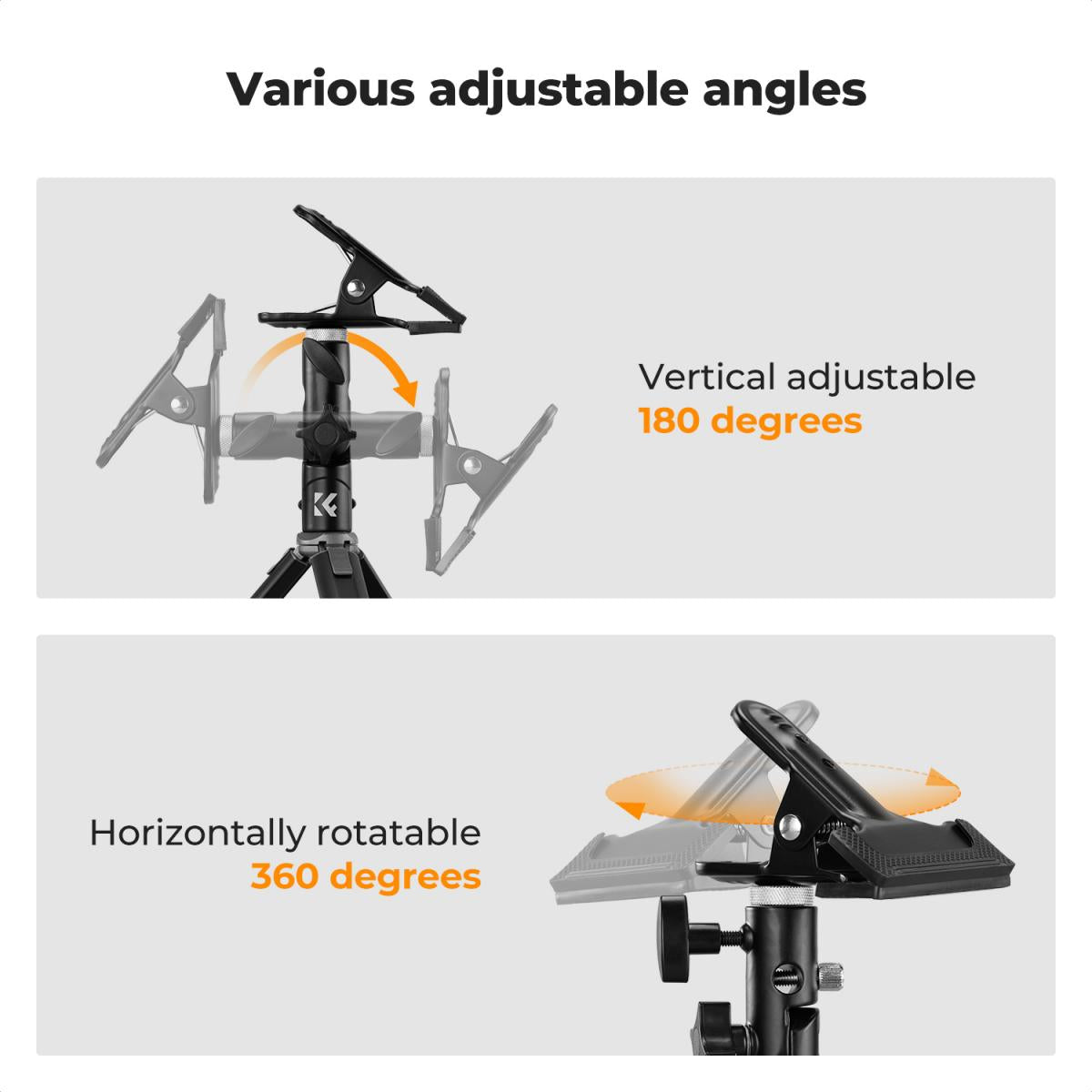
Articulation defines usability. This bracket offers 180 degrees of vertical tilt and 360 degrees of horizontal pan, both independently adjustable and lockable. In practical terms, that means you can mount a silver reflector at chest height on a stand, tilt it 45 degrees to bounce key light into shadow areas, then rotate it 90 degrees to redirect spill without loosening the stand collar or repositioning the entire assembly. The range covers overhead boom angles for hair light diffusion, low fill positions for clamshell setups, and side-mounted flags for negative fill, all from a single mounting point. Friction locks hold each axis firmly once set, so angles don't creep during long exposures or between takes.
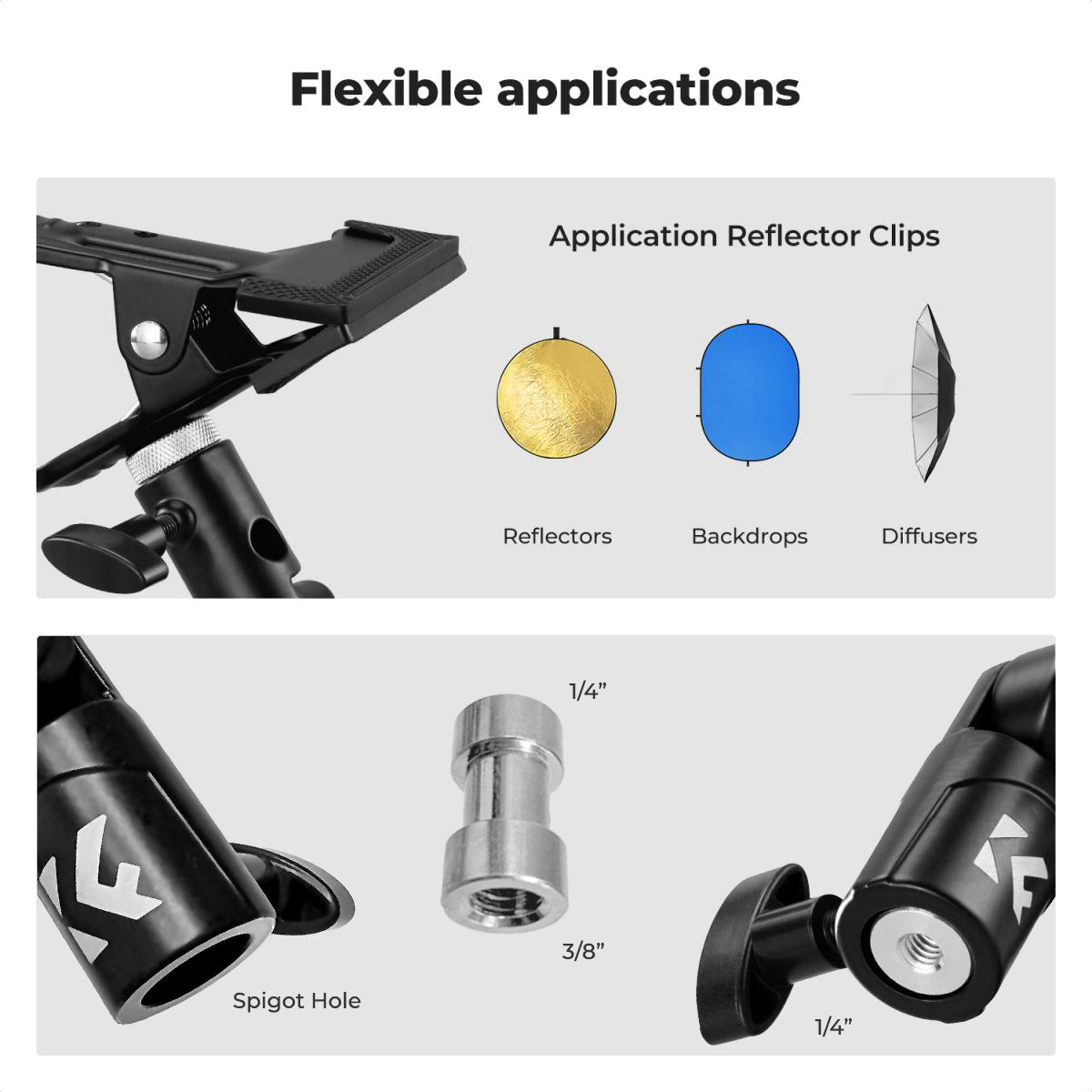
Compatibility spans the full range of studio mounting standards. The primary interface is a 5/8 inch receiver that slides directly onto any industry-standard light stand spigot, the same fitting used by strobes, speedlight brackets and boom arms. No adapters, no wobble, no guesswork about whether it will fit your existing stands. The bracket also incorporates a reversible internal spigot with 1/4 inch and 3/8 inch female threads on opposite ends, turning it into a junction point for accessories that don't use the 5/8 inch standard. Thread a small articulating arm into the 1/4 inch side to hold a colour gel swatch, or use the 3/8 inch end to attach a secondary clamp for a backdrop hook. This dual-thread design eliminates the need to carry separate adapter bushings in your location kit.
Physical footprint matters when you're packing for a client shoot or working in a home studio with limited storage. At 17.5 × 11.0 × 8.0cm assembled, the bracket occupies less space than a collapsed umbrella and weighs less than a mid-range zoom lens. It doesn't fold, but the compact form means it drops into a lighting case or backpack side pocket without requiring dedicated compartments. The 245g mass is light enough that mounting it high on a stand doesn't shift the centre of gravity enough to require sandbag counterweights, yet the metal construction ensures it won't flex under the torque of a large reflector catching air movement from a fan or open door.
Durability comes from material choice and mechanical simplicity. The black metal body resists deformation from repeated tightening cycles, and the spring mechanism uses a coil design that maintains tension over thousands of open-close cycles without losing grip strength. There are no plastic gears, no electronic components to fail, no batteries to replace. The padded contact surfaces are replaceable if they eventually compress, but the core structure is built to outlast the average studio's equipment refresh cycle. This is a tool you buy once and expect to function identically five years later.
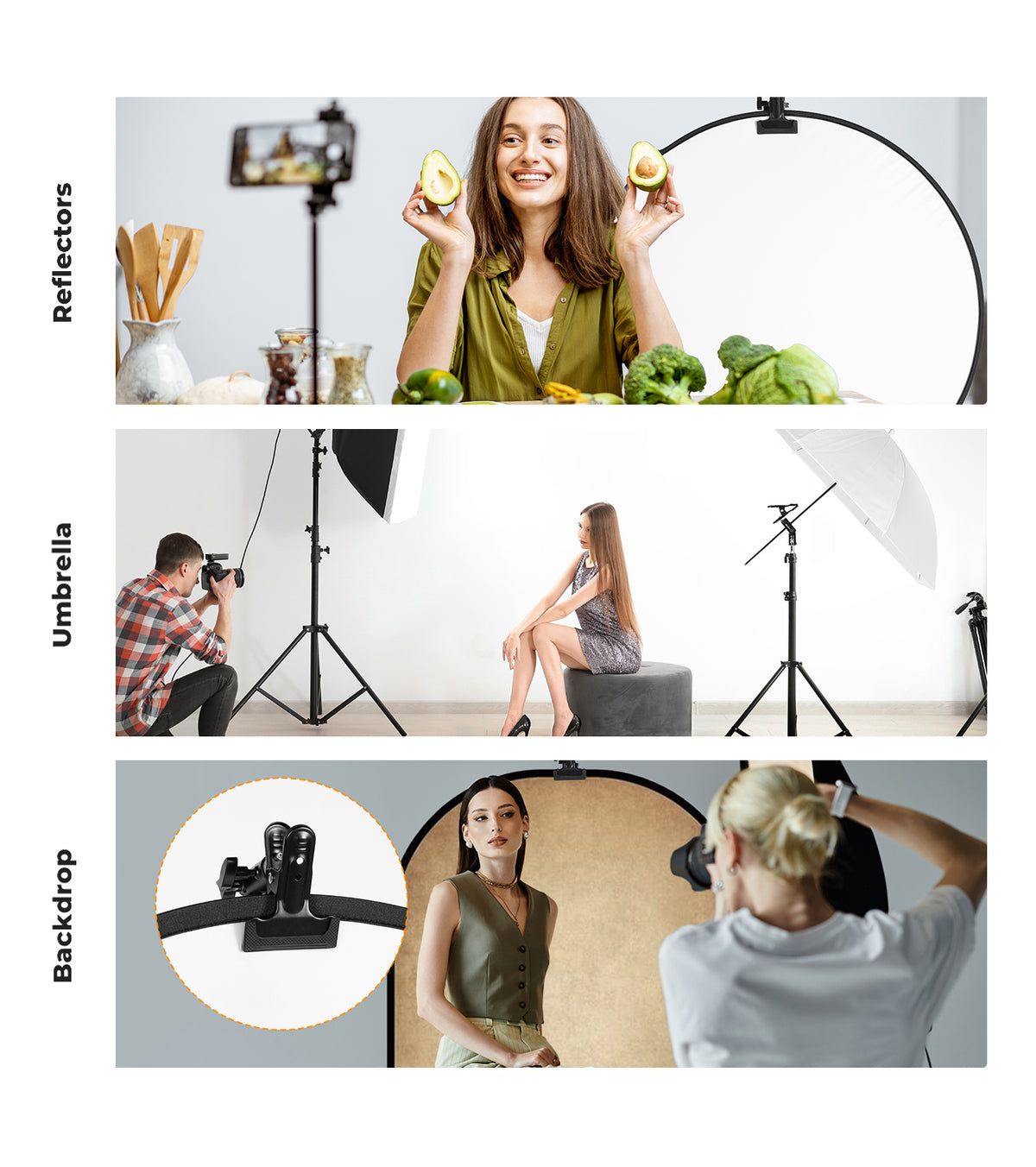
Real-world application scenarios clarify where this bracket earns its place in a working kit. For product photographers shooting reflective surfaces, it holds a black flag precisely angled to kill lens flare without appearing in the chrome edge of a watch case. For portrait shooters using natural window light, it clamps a translucent diffuser at the exact height and angle needed to soften harsh midday sun into flattering wrap-around illumination. For backdrop work, it grips a muslin edge taut against a crossbar, preventing the fabric sag that creates distracting shadows in full-length fashion shots. For umbrella users, it provides a secondary mounting point when you need to stack a shoot-through umbrella with a reflective one on the same stand for layered diffusion effects.
The bracket's value proposition is straightforward: it removes a category of friction from the lighting setup process. Instead of gaffer-taping a reflector to a stand, balancing it on a chair, or asking an assistant to hold it for twenty minutes, you clamp it securely and adjust it in seconds. Instead of compromising on angle because your existing clamp only pivots in one axis, you dial in the exact geometry the shot requires. Instead of worrying whether a gust of wind will collapse your diffusion setup during an outdoor portrait session, you trust the spring tension to hold fast. These aren't dramatic improvements, they're the small efficiencies that compound across a day's shooting into measurably faster turnarounds and fewer retakes.
For photographers transitioning from natural light to controlled studio lighting, this bracket represents a low-risk entry point into modifier positioning. It works with the light stands you already own, accepts the reflectors and diffusers you're already using, and costs less than a single rental day at a commercial studio. For established professionals, it's a redundancy tool, the backup clamp that lives in your location kit so you're never stuck improvising a mount with binder clips and hope. For educators running workshops, it's the piece of kit that lets students experiment with light shaping without needing a dedicated grip assistant, making advanced techniques accessible to solo shooters.
The KF18.0014 doesn't reinvent studio lighting, but it solves a persistent problem with uncommon thoroughness. Secure grip, full articulation, universal compatibility, and durable construction in a portable form factor, these are the attributes that define a tool worth carrying. Whether you're building your first home studio or refining a professional location kit, this bracket delivers the control and reliability that turn lighting theory into repeatable results.