
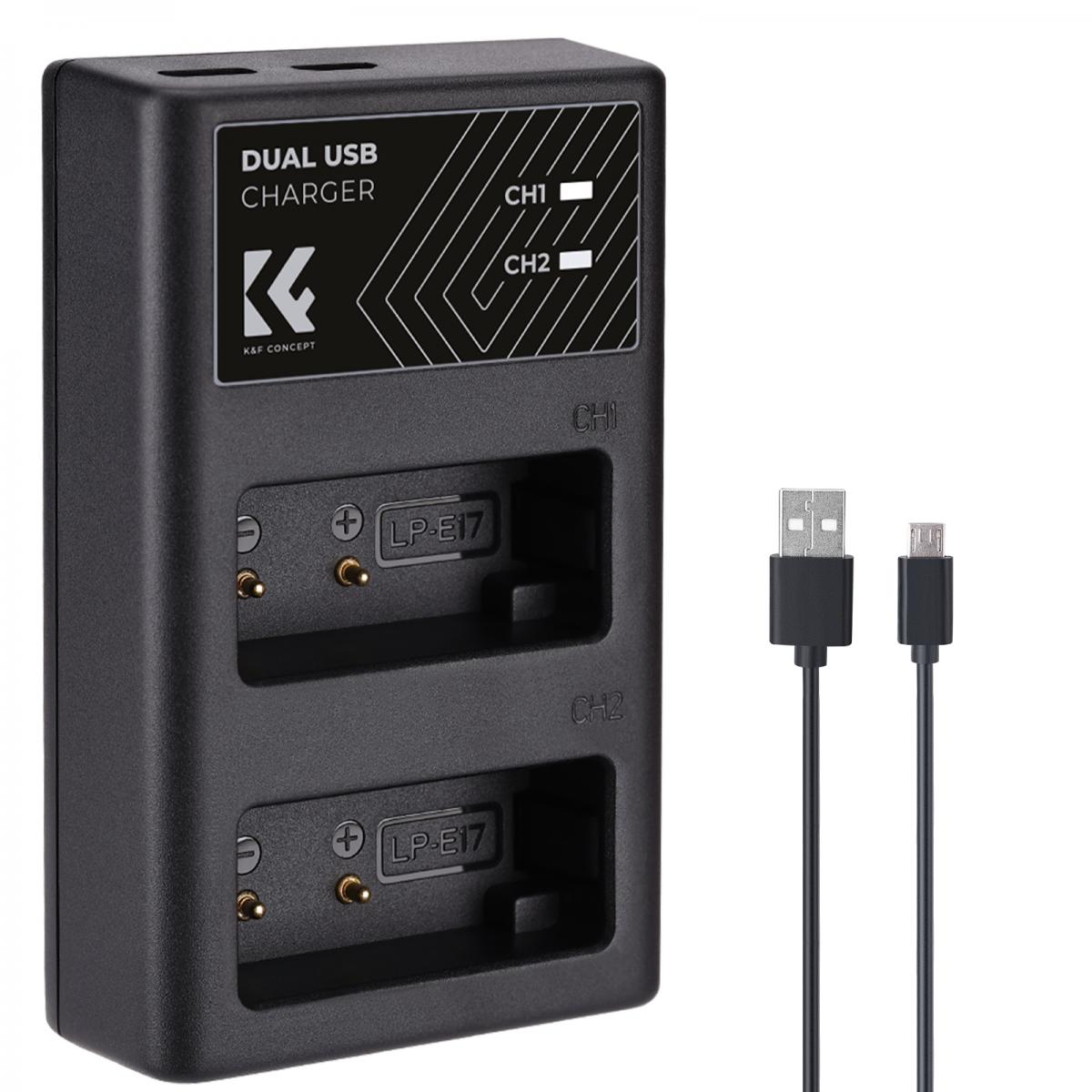


K&F Dual Charger for Canon LP-E17 batteries
Dual-Bay USB Charging for LP-E17 Bodies
Mirrorless shooters running Canon EOS M or Rebel T-series bodies know the reality: one battery rarely covers a full day, and video work drains cells faster still. This dual-slot USB charger addresses that constraint directly by topping up two LP-E17 packs in parallel, halving downtime between shoots and ensuring a rotation of ready cells when you need them.
Both charging bays operate independently, so you can drop in a single depleted battery or two at once without waiting for one to finish before the next begins. LED indicators above each slot show live charge state, removing guesswork and letting you pull a battery the moment it hits full capacity. The result is a tighter workflow: swap, charge, shoot, repeat.
Power From Anything With a USB Port
The charger draws current through USB-C or Micro-USB, and both input sockets sit on the unit simultaneously. That dual-input design means you can use whichever cable you already carry,USB-C from a laptop or power bank, Micro-USB from an older wall adapter or car socket,without hunting for a specific connector. A USB-A to USB-C cable ships in the box, but any standard USB power source will work: mains adapter, portable battery pack, vehicle 12V socket, even a solar panel with USB output on a multi-day trek.
This flexibility turns the charger into a field tool rather than a mains-only accessory. Charge batteries in a vehicle between locations, top them up from a 10,000mAh power bank in a camera bag, or run the unit from a laptop USB port while editing in a hotel room. The charger becomes as mobile as the camera itself, which matters when mains power is intermittent or absent.
Eight-Layer Protection Circuit
An onboard management chip monitors voltage, current and temperature across both bays in real time, cutting power if any parameter moves outside safe limits. The protection array covers over-voltage, over-current, over-charge, over-discharge, short circuit, over-power, high temperature and recovery faults,eight distinct fail-safes that prevent the charger from damaging cells through electrical stress or thermal runaway.
This active monitoring extends battery lifespan by avoiding the voltage spikes and heat build-up that degrade lithium-ion chemistry over repeated cycles. Cells charged under controlled conditions retain capacity longer and deliver more consistent runtime across their service life, which translates to fewer replacements and lower cost per shoot over the years you own the batteries.
Compatibility Across Canon LP-E17 and Third-Party Equivalents
The charger accepts any LP-E17-format battery, whether Canon OEM or third-party equivalent. It recognises the cell chemistry and adjusts charge current accordingly, so you can mix brands across the two bays without manual switching or risk of incorrect charging profiles. This cross-compatibility matters if you run a mix of original and aftermarket batteries to balance cost and capacity, or if you're transitioning from one to the other and need a charger that handles both.
Canon bodies using LP-E17 include the EOS M3, M5, M6, M6 Mark II, Rebel T6i, T6s, T7i, SL2, SL3, EOS RP (with adapter) and 77D, 200D, 750D, 760D, 800D, 8000D models depending on region. If you shoot any of these cameras and carry more than one battery, this charger removes the bottleneck of sequential charging that forces you to wait hours for a full rotation of cells to be ready.
Compact Enough to Travel, Robust Enough to Last
The housing measures compact enough to slip into a camera bag's accessory pocket without displacing lenses or other gear, yet the build quality avoids the flex and fragile sockets common in ultra-lightweight chargers. The USB ports sit recessed to resist damage from cable strain, and the battery contacts are spring-loaded to maintain firm electrical connection even when the unit is jostled in transit.
Weight stays low enough that the charger doesn't noticeably add to a daypack's load, but the construction feels solid rather than hollow. This balance makes it practical for both studio use,where it sits on a bench charging spares throughout a session,and location work, where it travels in a bag and charges from whatever power source the environment offers.
Why Dual-Bay Charging Changes Your Battery Strategy
Single-bay chargers force a linear workflow: one battery charges while others sit idle, and you wait for each to complete before starting the next. Dual-bay parallel charging collapses that timeline, letting you prepare two batteries in the time a single-slot unit would take for one. That efficiency compounds across a multi-day shoot or a busy event calendar, where having a full set of charged cells at the start of each day determines whether you can work continuously or need to pause mid-session.
The ability to charge from USB rather than mains also decouples your power strategy from wall sockets, which expands where and when you can top up batteries. A 20,000mAh power bank can fully charge four to six LP-E17 cells, turning a portable battery into a mobile charging station that works in a vehicle, on a plane, or in a field location hours from the nearest outlet. That flexibility is the difference between rationing shots to conserve power and shooting freely because you know you can recharge anywhere.
K&F Concept designed this charger to solve the specific constraint that mirrorless shooters face: high power consumption, multiple batteries in rotation, and the need to charge quickly from whatever power source is available. It does that job without unnecessary features or inflated claims,just two bays, intelligent charging logic, and the input flexibility to work in any environment where you're shooting. KF28.0008.