
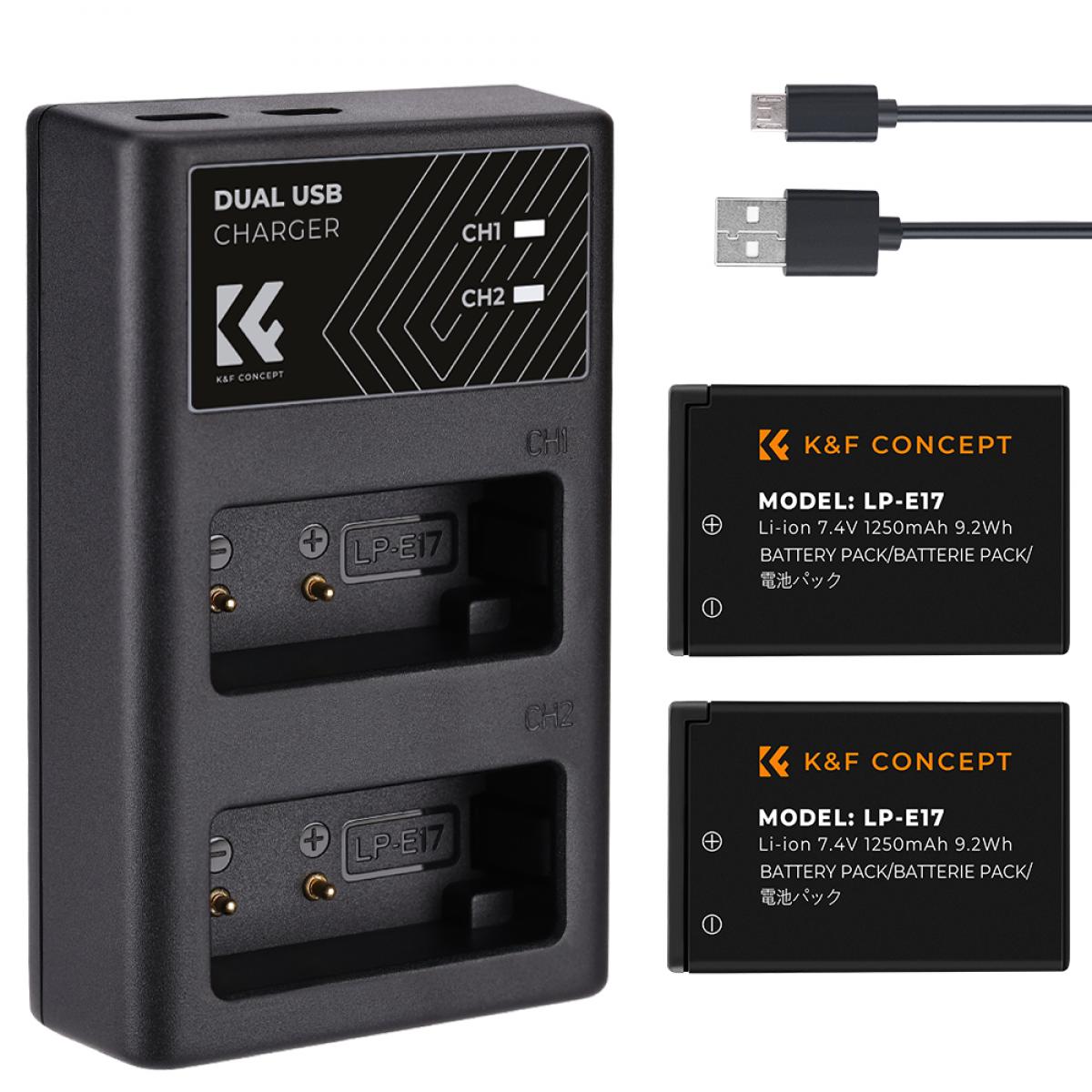



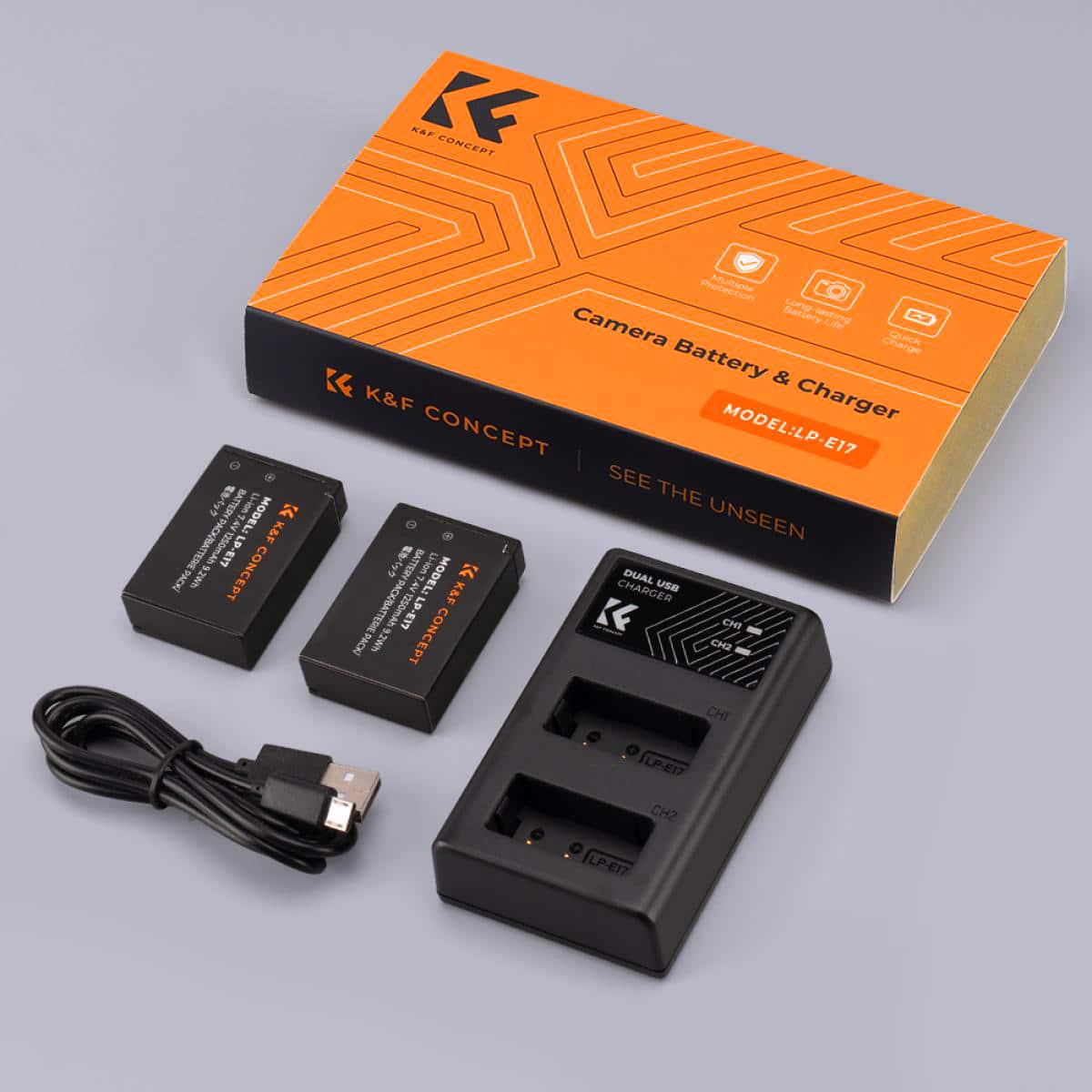

K&F Canon LP-E17 Battery kit - 2 Batteries and Dual Charger
Power Management Built Around Real Shooting Scenarios
This kit pairs two 2250mAh lithium-ion cells with a dual-slot charger that runs off any USB power source. The setup addresses the core frustration of single-battery workflows: you're either shooting or charging, never both. With two cells cycling through the charger while one stays in the camera, you maintain continuous operation across multi-day shoots, location work where mains power isn't guaranteed, or any scenario where downtime costs you frames.
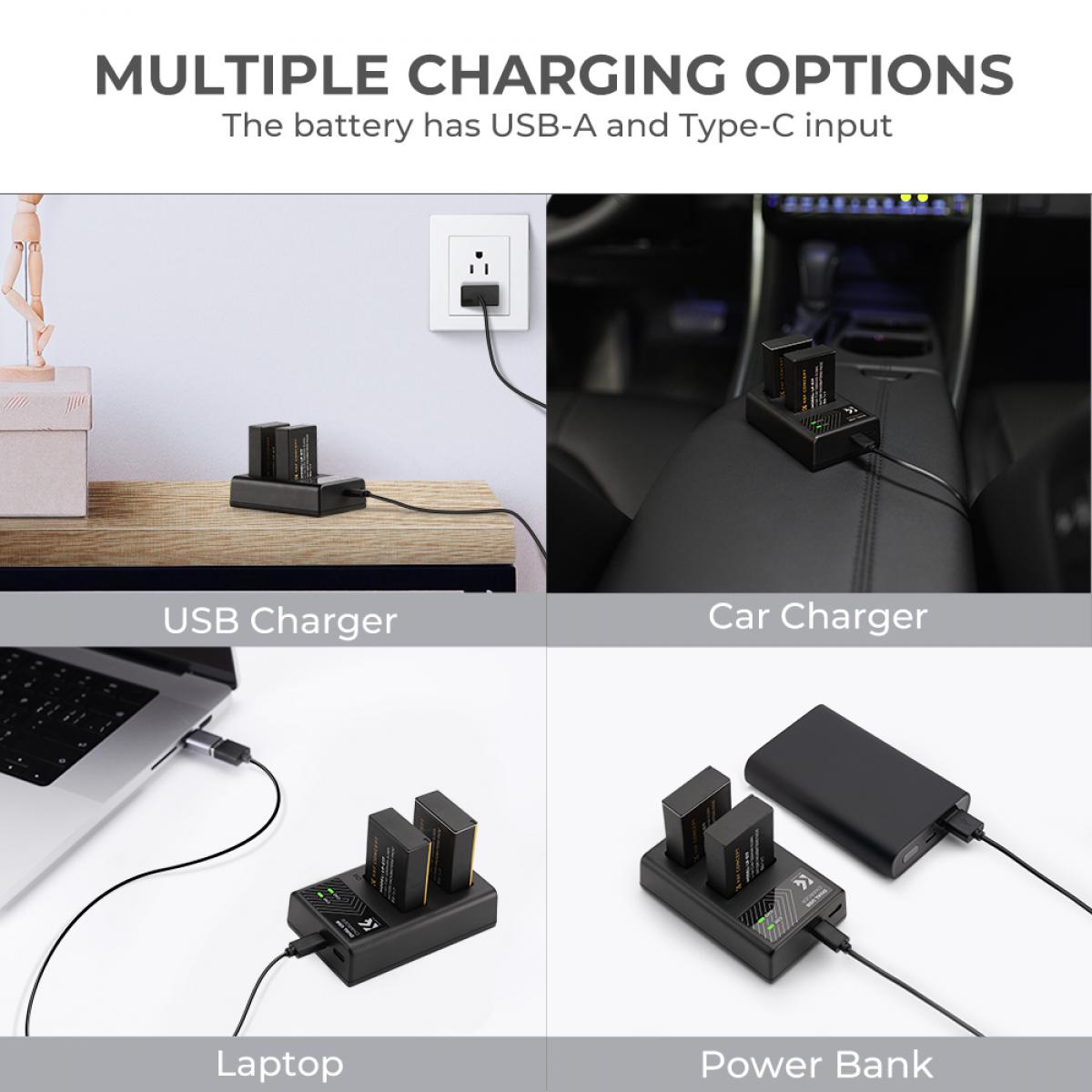
The charger accepts both USB Type-C and Micro-USB input, so you're not hunting for a specific cable when the battery indicator drops into the red. Power banks, laptop USB ports, car adapters, and wall sockets all work. That flexibility matters when you're moving between environments, studio to field to client meeting, and can't predict what charging infrastructure will be available. The dual slots mean both batteries reach full charge in parallel rather than queuing, cutting total recharge time roughly in half compared to swapping a single cell through a one-slot unit.
Eight-Layer Protection Architecture
The charger's integrated chip monitors voltage, current, and temperature across eight distinct failure modes: over-voltage, over-current, over-charge, over-discharge, over-power, short circuit, thermal runaway, and post-fault recovery. These aren't marketing abstractions, they're the specific ways lithium-ion cells degrade or fail when charging logic breaks down. Over-charging reduces cycle life by forcing the cell beyond its design voltage. Thermal runaway is the fire risk that comes from uncontrolled exothermic reactions inside a damaged or over-stressed pack. Short circuit protection prevents catastrophic discharge if the terminals bridge. The recovery safeguard ensures the charger won't attempt to charge a cell that's already been damaged by one of the other fault conditions, which would compound the problem.
This protection layer sits between your power source and the cells, so a voltage spike from a cheap car adapter or a failing power bank doesn't propagate through to the battery chemistry. That containment extends usable lifespan and reduces the odds of a cell swelling, venting, or refusing to hold charge after a few months of field use.
Capacity and Cycle Behaviour
Each 2250mAh cell delivers roughly 450-650 frames per charge on a typical APS-C mirrorless body, depending on whether you're shooting stills with the EVF off or recording 4K video with continuous autofocus. The actual count varies with ambient temperature, how often the camera wakes from standby, and whether you're using power-hungry features like in-body stabilisation or high-speed burst mode. Cold conditions, below 10 °C, will shave 15-25% off that estimate as the internal resistance of the lithium-ion chemistry rises.
New cells require three full discharge-recharge cycles to reach their rated capacity. The first charge out of the box typically delivers 80-85% of the nominal figure because the electrolyte hasn't fully saturated the electrode surfaces. By the third cycle, you'll see the full 2250mAh available. This isn't a defect; it's how lithium-ion cells condition themselves during initial use.
Store cells at 40-60% charge if they're sitting unused for more than two weeks. A fully charged cell left idle will self-discharge faster and experience more calendar aging than one held at mid-state. Never let a cell drop below 20% and sit there for days, deep discharge stresses the chemistry and can trigger the over-discharge protection, which may lock the cell out of the charger until you perform a recovery charge.
Compatibility and Integration
These cells match the LP-E17 form factor and communicate correctly with Canon bodies that expect that battery type. The camera's fuel gauge reads remaining capacity accurately, and the charger recognises both OEM Canon LP-E17 cells and K&F Concept equivalents, so you can mix and match across your kit without needing separate charging infrastructure. The protection chip inside each cell speaks the same protocol the camera uses to query state-of-charge, so you won't see spurious warnings or incorrect percentage readings on the LCD.
The charger's USB input accepts 5V at up to 2.1A, which is the standard output from most phone chargers, power banks, and laptop USB ports. If your power source can only supply 1A, the charger will still work but will take longer to fill both cells. A 2A supply completes a dual charge in roughly 2.5-3 hours from empty; a 1A supply stretches that to 4.5-5 hours.
Field Durability and Thermal Limits
The cells tolerate operating temperatures from 0 °C to 40 °C, with charging permitted between 10 °C and 35 °C. Outside that charging window, the protection chip will refuse to accept current to prevent lithium plating on the anode, which permanently reduces capacity. If you're shooting in sub-zero conditions, keep spare cells inside your jacket until you need them, body heat maintains enough warmth to preserve performance. In high-heat environments above 35 °C, avoid leaving cells in direct sunlight or a closed car; sustained exposure above 60 °C can trigger thermal protection or, in extreme cases, cause the cell to vent.
The outer casing is impact-resistant ABS, but it's not indestructible. A hard drop onto concrete can crack the shell and expose the internal pouch cell, which is a fire risk if the electrodes short against each other. Inspect cells after any significant impact, if the casing is deformed or the terminals are loose, retire the cell immediately.
Why Carry Spares
A single battery might cover a casual afternoon shoot, but it won't survive a wedding ceremony, a full day of event coverage, or a multi-location commercial job. Running out of power mid-shoot doesn't just pause your work, it breaks your rhythm, disrupts your subject's flow, and in time-sensitive scenarios like live events, it means you miss the frame entirely. Two spare cells in your bag eliminate that risk. You're never more than 30 seconds away from full power, and you can rotate cells through the charger during lunch breaks or transit between locations so you always have at least one fresh cell ready.
This approach also reduces wear on any single cell. Cycling three cells through 100 charge cycles each spreads the load more evenly than running one cell through 300 cycles, which extends the overall service life of your power system. Lithium-ion cells degrade with both cycle count and calendar age, so distributing the work across multiple cells delays the point where you need to replace the entire set.
Practical Workflow Integration
Charge both cells the night before a shoot so you start the day at 100%. Keep one in the camera and one in your pocket or bag. When the in-camera cell hits 20%, swap it out and drop the depleted cell into the charger if you have access to a USB port. If you're working off-grid, carry a 10,000mAh power bank, that's enough to recharge both cells once with capacity to spare. At the end of the day, plug the charger into a wall adapter and let both cells top up overnight. This rotation ensures you never start a shoot with less than two full cells available.
For multi-day location work where mains power is intermittent, prioritise charging during any window where you have grid access. A two-hour lunch stop with a power outlet is enough to bring both cells from 30% to 90%, which buys you another 800-1000 frames. If you're camping or working in remote areas, a small solar panel with USB output can trickle-charge the cells during daylight hours, though you'll need clear sun and several hours to complete a full charge.
The one-year warranty covers manufacturing defects and premature capacity loss, but not damage from misuse, punctures, water ingress, or charging outside the specified temperature range all void coverage. Register the product within 30 days of purchase to activate the warranty. If a cell swells, stops holding charge, or triggers the protection circuit without cause, contact support with the SKU KF28.0014 and proof of purchase for a replacement assessment.