
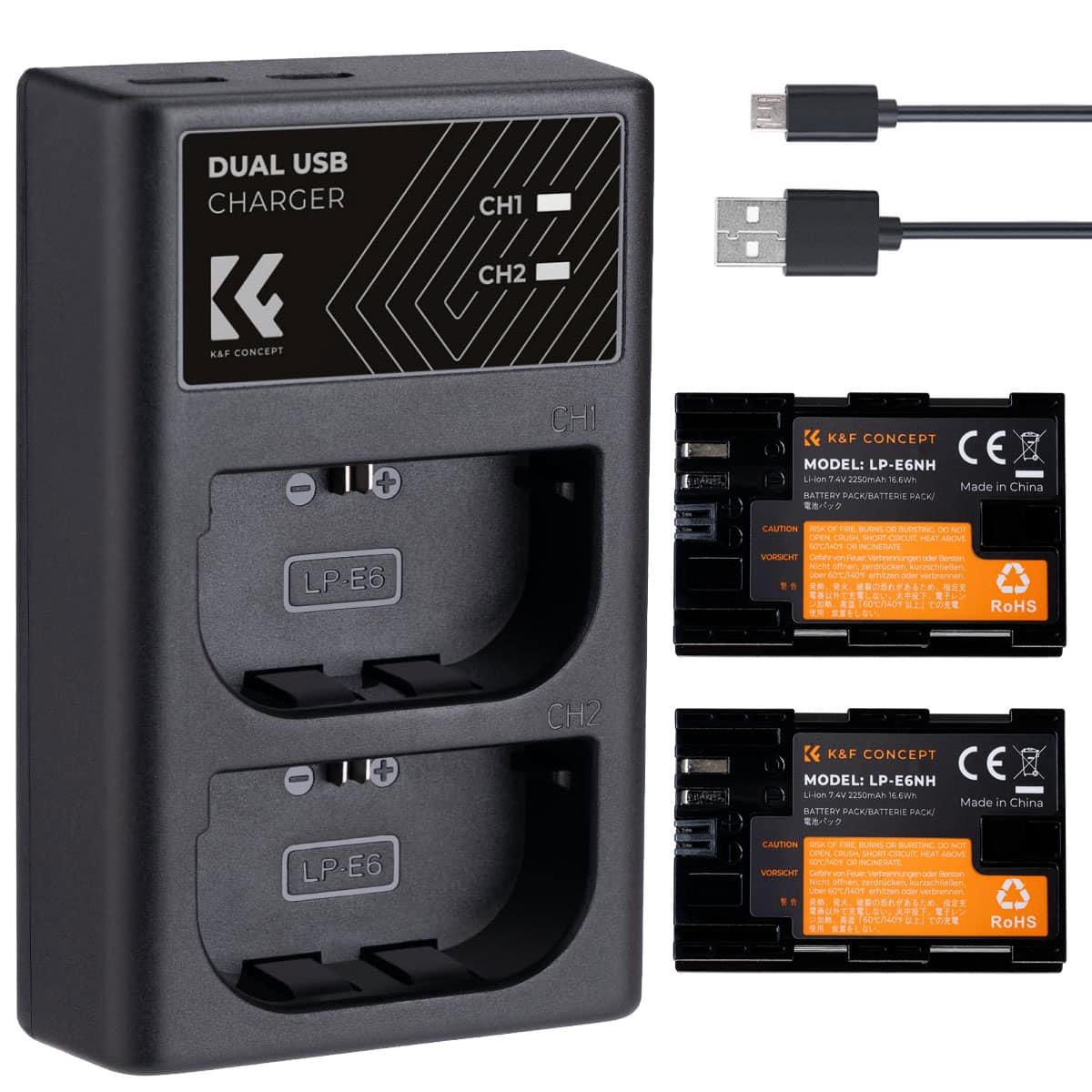


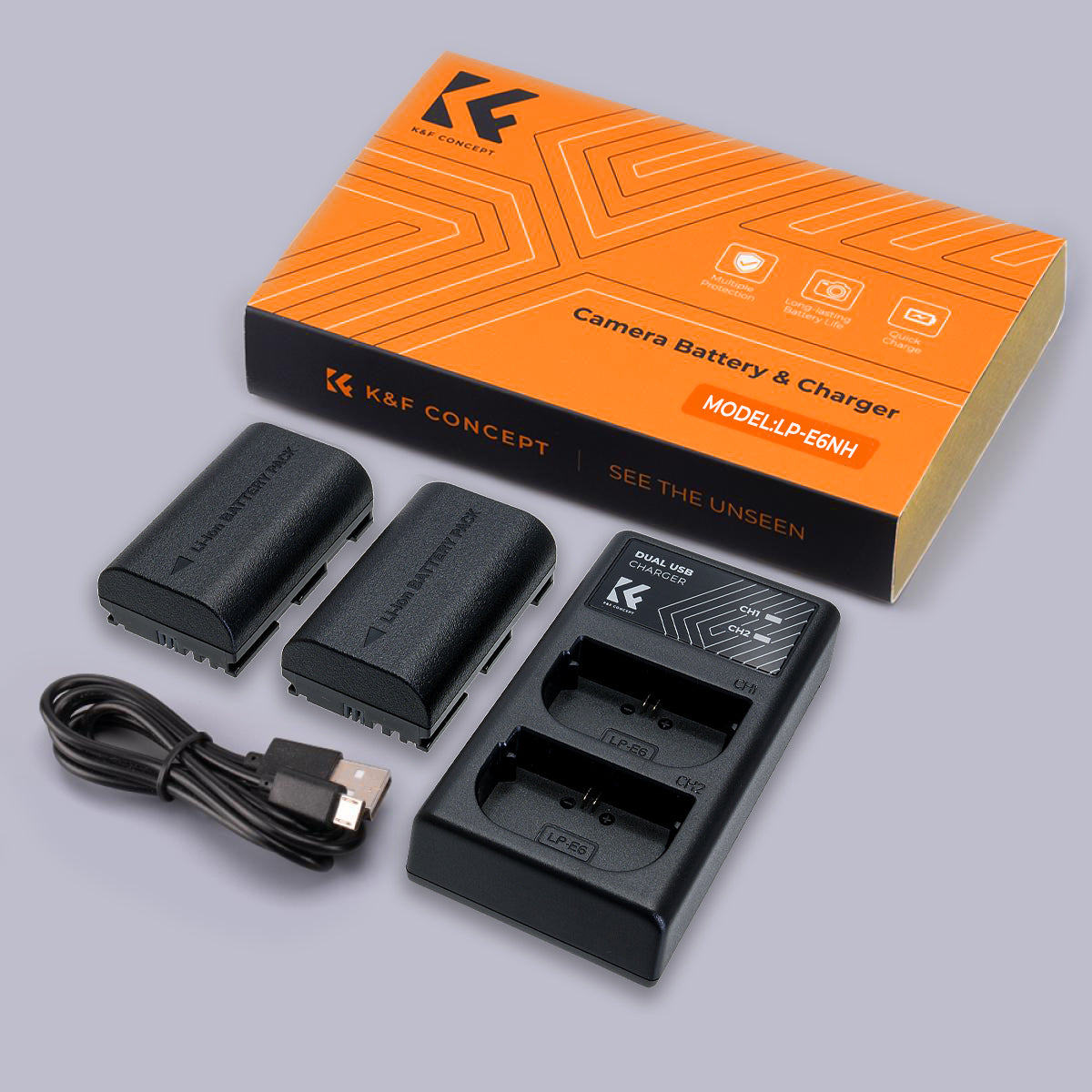
K&F Canon LP-E6NH Battery Kit - 2 Batteries and Dual Charger
Canon shooters know the LP-E6 platform inside out, it powers everything from the EOS 5D series through to the R5 and R6. What they also know is that OEM cells are expensive, and a day in the field rarely fits inside one battery's runtime. This kit solves both problems: two 2250mAh lithium-ion cells and a dual-slot USB charger that handles both simultaneously, so you're never waiting on a single slow trickle charge between shoots.
Power Capacity That Matches Real Shooting Days
A 2250mAh cell delivers roughly 16.6Wh of usable energy at 7.4V, enough for extended stills work or a solid block of 4K recording before you need to swap. The practical benefit isn't the number itself; it's what it buys you on location. Wedding photographers working ceremony through to first dance, travel shooters spending a full day away from mains power, hybrid shooters alternating between stills bursts and video clips, all scenarios where a second charged battery in the bag turns anxiety into confidence. You're not rationing shots or second-guessing whether to grab one more take. You shoot until the work is done, then swap.
Dual-Slot Charging Without the Outlet Dependency
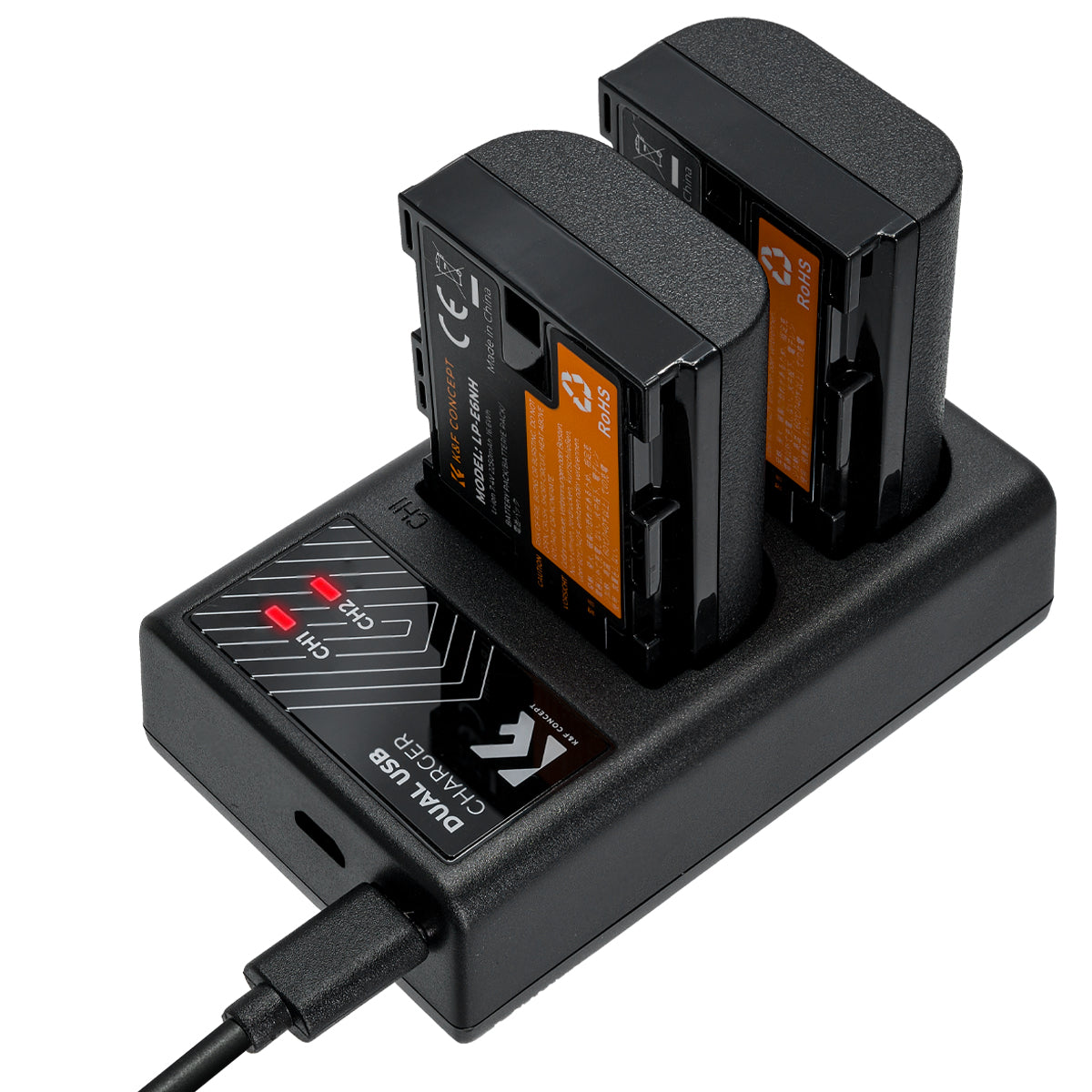
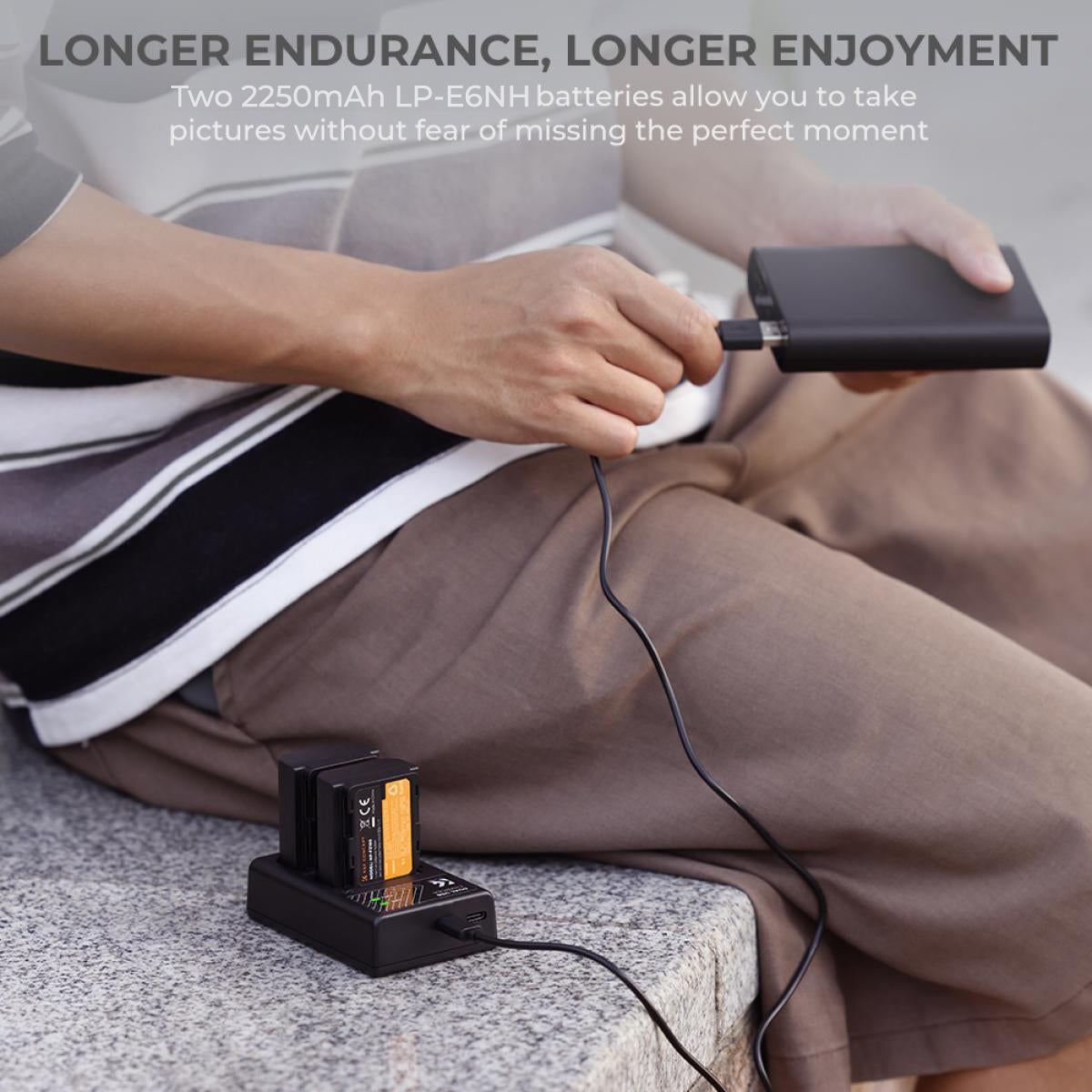
The included charger accepts two batteries at once, cutting total charge time in half compared to sequential charging. Both slots work independently, so you can top up one cell while the other is still out shooting, or recover both overnight and wake up to a full kit. Power delivery is via USB, either Type-C or the older micro-USB standard, both ports present on the unit, which means the charger draws from whatever's available. Laptop USB during an airport layover. Car adapter on a road trip. Mains via a phone charger brick. Power bank while hiking. The charger doesn't care; it pulls 5V input and manages cell chemistry internally. That flexibility matters when you're working outside the studio and can't guarantee a wall socket.
Protection Circuitry That Preserves Cell Lifespan
Lithium-ion cells degrade faster when abused, overcharged, overheated, drained too low, or pushed beyond their current rating. The integrated chip in this charger monitors eight failure modes: high temperature, over-current, over-charge, over-discharge, over-voltage, short circuit, over-power, and recovery faults. It's not marketing; it's basic battery management that keeps cells performing closer to their rated capacity across hundreds of cycles instead of fading after fifty. You're not replacing batteries every six months because the charger cooked them. The cells stay healthy, hold their charge longer between uses, and deliver consistent voltage under load, which translates to stable autofocus performance and fewer unexpected shutdowns mid-burst.
Cross-Compatibility Across the LP-E6 Family
Canon's LP-E6 platform has evolved through three iterations, LP-E6, LP-E6N, and LP-E6NH, each backwards-compatible but with incremental capacity or communication improvements. These cells work across all three standards, so they'll power an older 5D Mark III just as reliably as a current R6 Mark II. They also pair with existing Canon chargers if you already own one, and Canon OEM cells will charge in the K&F dual-slot unit. That interoperability matters when you're building a multi-battery kit over time or working in a team environment where gear gets shared. No proprietary lock-in, no format confusion, just drop the cell in the grip and shoot.
Field-Practical Dimensions and Weight
Each battery measures 56mm × 38mm × 21mm and weighs 77g, identical to OEM LP-E6 form factor. That's deliberate: they fit the same battery grips, the same spare slots in a camera bag, the same charger docks. There's no adapter bulk, no fitment compromise. If you're already carrying LP-E6 cells, these slot into the same workflow without adjustment. The charger itself is compact enough to live in a camera bag's front pocket alongside cables and cards, rather than demanding dedicated packing space.
Initial Conditioning and Long-Term Care
Lithium-ion cells perform best after a few charge-discharge cycles as the internal chemistry stabilises. Fully charge both batteries before first use, then run them through two or three normal shooting days with full recharges in between. Performance will settle into its rated capacity by the third cycle. Avoid physical damage to the outer casing, a punctured lithium-ion cell is a fire risk. Keep cells dry, away from conductive materials that could short the terminals, and out of environments above 60°C (direct sun in a parked car, for example). Cold weather will temporarily reduce capacity, but the cell recovers when warmed. These aren't special rules; they're standard lithium-ion care that applies to any rechargeable camera battery, OEM or third-party.
Why Two Batteries and a Dual Charger Matter
Most cameras ship with one battery and a single-slot charger. That's fine for casual use, but it falls apart the moment you're working to a deadline or can't afford downtime. One battery dies mid-shoot, and you're either done or waiting hours for a recharge. A second battery in the bag means you swap and keep working. A dual charger means both cells are ready the next morning without doubling your charge time. It's not about luxury; it's about removing the power constraint from your workflow so the limiting factor is your creative stamina, not your battery percentage.
This kit is built for photographers and videographers who've already learned the hard way that one battery isn't enough, the wedding shooter who's had to ration shots during speeches, the travel filmmaker who's missed golden hour waiting on a charge, the event photographer who's watched their camera die during the cake cutting. You're past the point of hoping your battery holds out. You plan for it. Two cells, one charger, USB power wherever you find it. The rest is just shooting.