

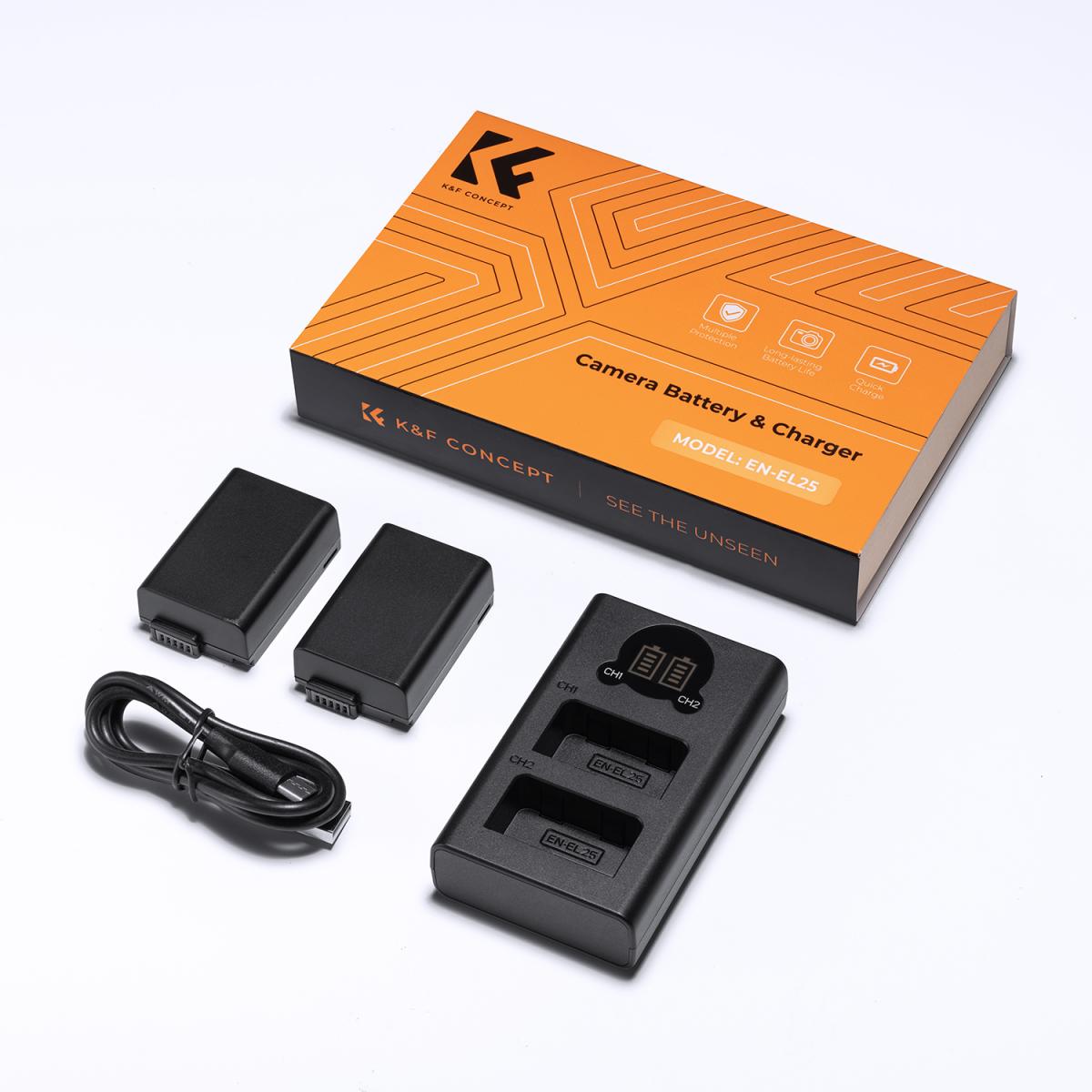


K&F Nikon EN-EL25 Battery Kit - 2 Batteries and Dual Charger
When you're deep into a shoot and the low-battery warning flashes, momentum dies. This dual-battery kit with its own USB charger removes that friction point entirely. You get two 1600mAh lithium-ion cells and a twin-slot charging dock that runs off any USB power source, laptop, power bank, car adapter, mains socket via USB plug. No proprietary wall-wart required. Both batteries charge simultaneously, so downtime between sessions shrinks to whatever else you were doing anyway.
Power Anywhere, Charge Anything
The charging dock accepts both USB-C and micro-USB input. Pack the included USB-A to USB-C lead, or use whatever cable is already in your bag. That dual-port flexibility means you're never hunting for the right connector when you're travelling or working remotely. Plug into a laptop during a client review, top up from a portable battery pack on a hike, or run it from the 12V socket in a hire car between locations. The dock works with the original Nikon EN-EL25 cells as well as these equivalents, so you can mix and match across your existing spares without needing a second charger.
Six-Layer Protection Architecture
An integrated management chip monitors each cell independently. High-temperature cutoff prevents thermal runaway. Over-current, over-voltage and over-charge limiters stop the chemistry from being pushed beyond safe operating windows. Over-discharge protection preserves cell health when a battery sits unused for weeks. Short-circuit lockout kills power instantly if a fault develops. These aren't marketing checkboxes, they're the reason lithium-ion cells last years instead of months. The chip also balances charge rates across both slots, so neither battery gets stressed by uneven current draw.
Extended Runtime for Multi-Day Projects
A 1600mAh cell delivers roughly the same shot count as the OEM battery your Z fc or Z 30 shipped with. That matters less for a half-hour portrait session and more when you're shooting an all-day event, a multi-location commercial job, or a weekend away where mains power isn't guaranteed. Two fully charged spares mean you can shoot morning to evening without rationing frames or second-guessing whether to chimp that last take. For video work, where the Z 30's 4K recording drains power faster than stills, having three or four cells in rotation (these two plus your in-camera original) turns a marginal setup into a reliable one.
Lithium-Ion Chemistry, Properly Managed
These cells use the same lithium-ion chemistry as the Nikon original: energy-dense, low self-discharge, no memory effect. You can top them up after every shoot without degrading capacity, and they'll hold 80-90% charge after sitting in a drawer for three months. The protection circuitry inside each battery talks to the camera's own power-management system, so the Z fc's battery indicator reads accurately and the camera shuts down cleanly when voltage drops below safe thresholds. That handshake prevents the "battery not recognised" errors that plague cheaper third-party cells with no onboard logic.
First-Use Conditioning and Long-Term Care
Fully charge both batteries before their first outing. Lithium-ion cells perform best after three full discharge-recharge cycles, so don't judge runtime on day one. After that break-in period, capacity stabilises and you'll see consistent shot counts. Store spares at 40-60% charge if they'll sit unused for more than a month, a completely drained cell degrades faster, and a fully charged one under storage stress ages the chemistry prematurely. Keep them dry, avoid impacts that could puncture the casing, and don't leave them in a car boot during summer when interior temperatures can spike above 60 °C. Cold weather temporarily reduces output voltage, so if you're shooting in sub-zero conditions, keep a spare in an inside pocket where body heat maintains cell temperature.
Why This Kit Works
You're not buying these batteries because they're exotic, you're buying them because running out of power mid-shoot is a solved problem, and the solution is carrying charged spares. The value here is the bundled charger that doesn't tie you to a wall socket, the protection circuitry that prevents expensive failures, and the 1600mAh capacity that matches OEM performance without the OEM price. Whether you're a working professional billing by the hour or an enthusiast who'd rather spend budget on glass than consumables, the calculation is the same: downtime costs more than a second battery ever will.
The dock's LED indicators show charge status at a glance, red while charging, green when complete. No guesswork, no babysitting. Slot both batteries after a shoot, plug into whatever USB source is nearby, and you're ready for tomorrow. The 54-gram cell weight is identical to Nikon's own, so balance and handling don't shift when you swap. Dimensions match exactly, so there's no play in the battery door and no risk of poor contact causing intermittent power.
This kit ships with a 1-year warranty covering manufacturing defects. If a cell develops a fault or the charger stops recognising batteries, replacement is straightforward. That's the floor, not the ceiling, properly cared for, lithium-ion cells in this class routinely deliver 500+ charge cycles before capacity drops noticeably, which for most users translates to several years of service.
K&F Concept engineers these cells to meet or exceed OEM specifications. Voltage output is 7.6V, matching the EN-EL25's nominal rating. Watt-hour capacity sits at 12.16Wh, within the threshold for carry-on luggage on commercial flights without special documentation. The lithium-ion chemistry is the same formulation used across the industry for mirrorless camera batteries, proven, stable, and compatible with the Z-mount bodies' power-management firmware.
If you're still running on the single battery that came with your Z fc or Z 30, you've already hit the limit of what that setup can do. Add this kit, KF28.0031, and the constraint shifts from power to something else you can actually control.