
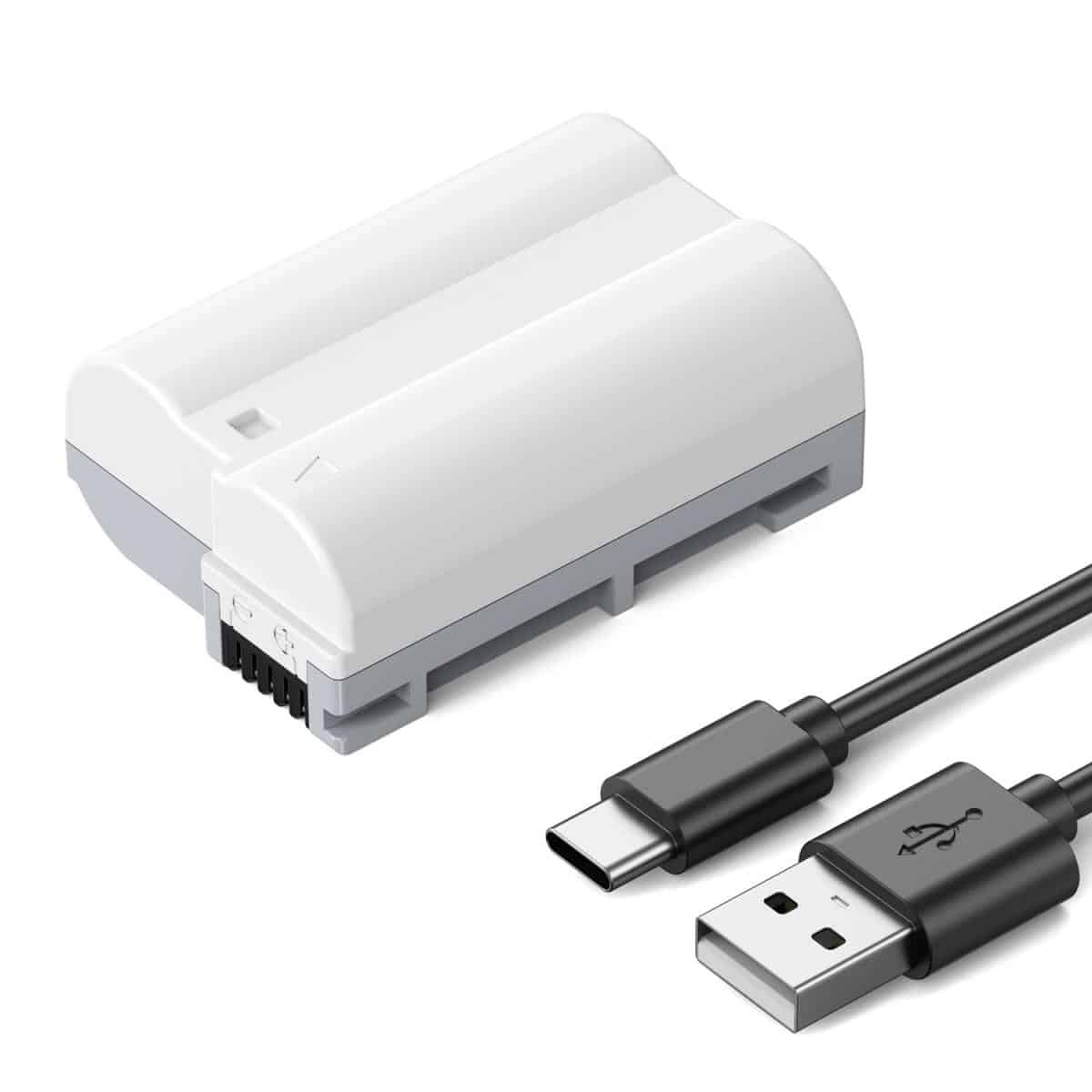


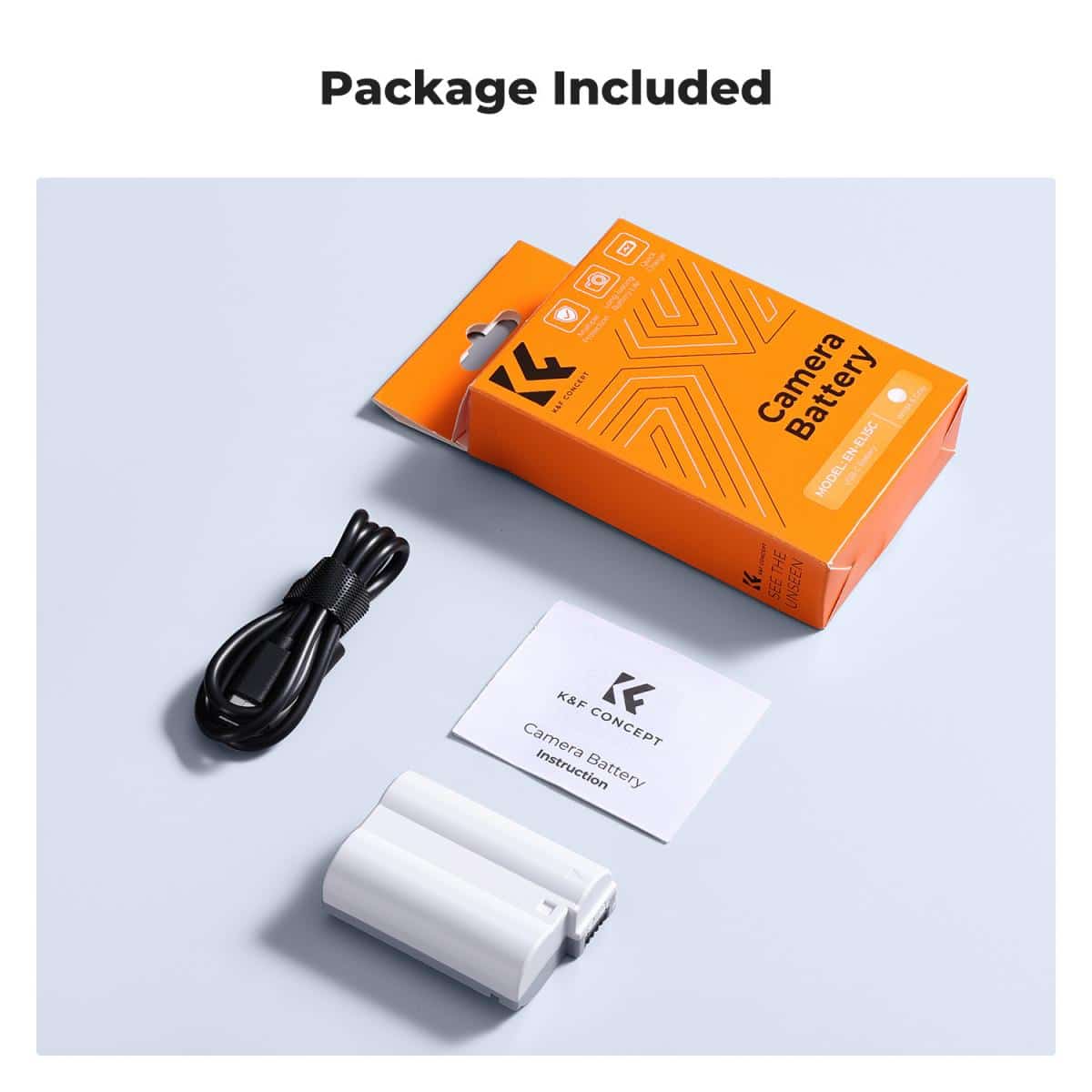

K&F EN-EL15C Camera Battery for Nikon with USB-C Charging Port
Power Without Compromise
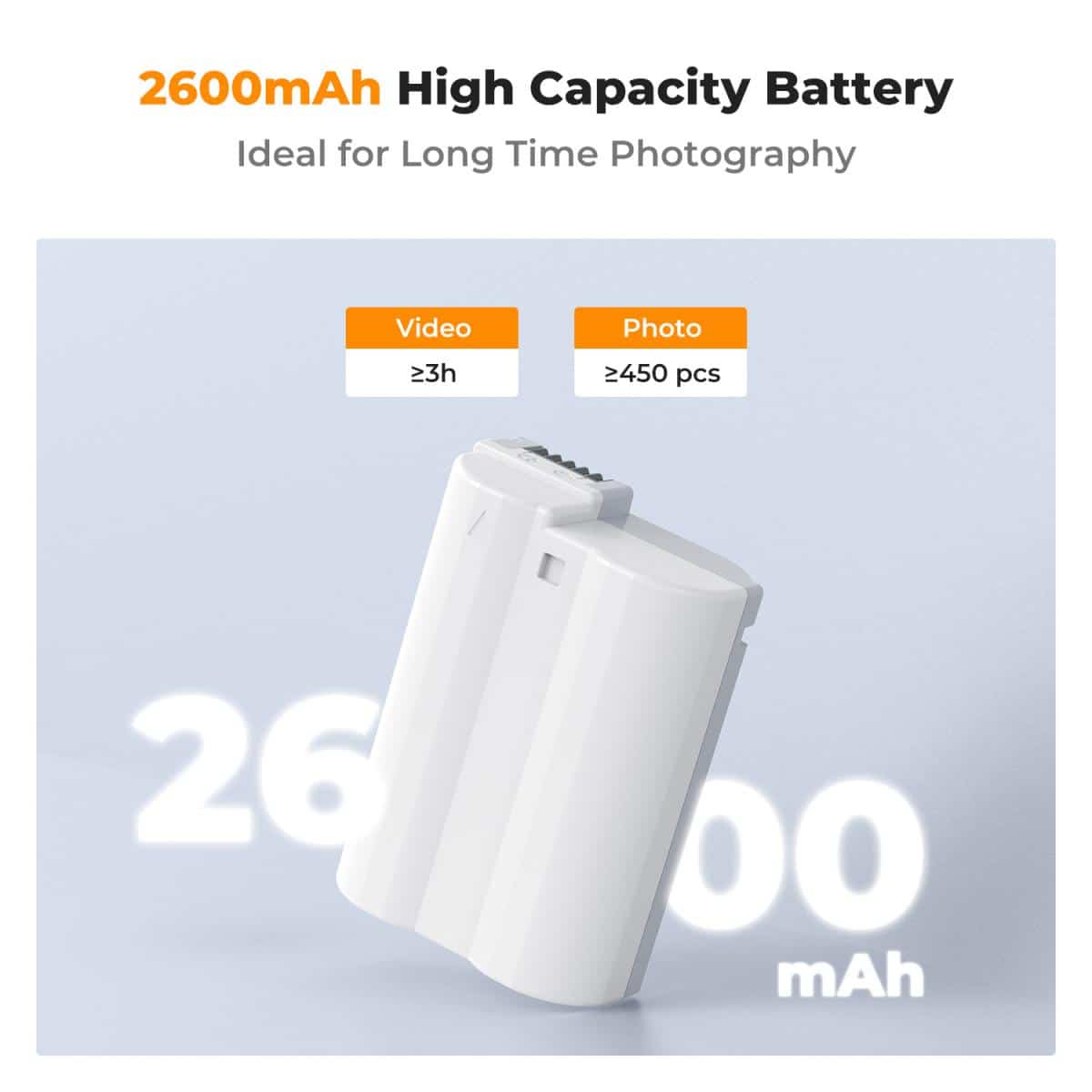
Built around a 2600mAh lithium-ion cell, this replacement delivers measurably more capacity than Nikon's original EN-EL15C, enough headroom to matter when you're shooting a full-day event or working through a multi-location travel itinerary without mains access. The difference shows up in shot count: where the OEM battery might leave you hunting for an outlet by mid-afternoon, this equivalent keeps the shutter firing through the tail end of golden hour. That extra margin isn't marketing spin; it's the outcome of fitting a denser cell into the same form factor, and it changes how confidently you can plan a shoot.
The capacity advantage matters most when you're stacking power draws, live view composition, back-button focus hunting in low light, interval timer sequences, or any sustained video work that keeps the sensor and processor active. A higher-capacity cell doesn't just buy you more frames; it reduces the number of times you need to interrupt your workflow to swap batteries, which in turn reduces the number of moments you're not ready when the shot presents itself.
Integrated USB-C Charging
The defining feature here is the USB-C port machined directly into the battery casing. You charge the cell by plugging a cable into the battery itself, no standalone charger, no need to slot it into the camera body, no additional brick to pack. The included USB-A to USB-C cable connects to any USB power source: a laptop, a mains adapter, a car charger, a powerbank. If you're already carrying a phone charger or a portable battery pack for your other devices, you're carrying everything you need to top up this cell.
That design choice collapses the charging ecosystem. A traditional setup requires you to track the battery, the charger, the charger's cable, and potentially a regional plug adapter if you're travelling. Lose the charger and the battery becomes dead weight until you source a replacement. Here, the only additional item is a cable, the same cable you're already using for half the devices in your bag. The risk of being stranded with a flat battery because you left the charger in a hotel room two cities ago drops to near zero.
The port supports fast-charge protocols, so when you connect to a quality USB power delivery adapter, a full recharge completes in approximately 2.5 hours. That's fast enough to recover a depleted cell over lunch or during a drive between locations. The battery housing includes an LED indicator: red while charging, green when complete. No guesswork, no need to check a separate charger's status lights.
Six-Layer Protection Architecture
Lithium-ion cells are energy-dense, which makes them effective and also makes their failure modes consequential. This battery integrates six discrete protection circuits: overcharge cutoff, overcurrent limiting, overdischarge prevention, short-circuit isolation, overheat shutdown, and overvoltage protection. Each layer monitors a different failure vector and intervenes before the cell enters an unsafe state.
Overcharge protection matters during the final phase of a charge cycle, when the cell is near full capacity and continued current input risks thermal runaway. The circuit cuts power delivery once the cell reaches its voltage ceiling. Overcurrent limiting prevents damage if you connect to a power source that tries to push more amperage than the cell can safely absorb. Overdischarge protection stops the camera from draining the cell below the threshold where permanent capacity loss occurs, this is what preserves the battery's long-term health across hundreds of cycles.
Short-circuit isolation is the failsafe for accidental contact scenarios: keys in a bag, a dropped battery landing on conductive debris, any situation where the positive and negative terminals bridge. The circuit breaks the connection before the cell can dump its stored energy in a single catastrophic discharge. Overheat shutdown monitors internal temperature and cuts all activity if the cell approaches the point where chemical breakdown begins. Overvoltage protection guards against faulty chargers or power surges that could force the cell beyond its design limits.
These protections are not theoretical. They're the difference between a battery that degrades gracefully over years of use and one that swells, vents, or fails outright after a few dozen cycles. The architecture is certified to CE and RoHS standards, meaning it has passed third-party testing for electrical safety and hazardous substance limits.
No Memory Effect, Optimised After Three Cycles
Lithium-ion chemistry eliminates the memory effect that plagued older nickel-cadmium cells, where partial discharge cycles would permanently reduce usable capacity. You can top up this battery at any state of charge, 80%, 50%, 20%, without degrading its long-term performance. That flexibility matters in real-world use: you're not forced to fully drain the cell before recharging, and you're not penalised for topping up opportunistically between shoots.
The cell ships with a partial factory charge and is ready to use immediately after a top-up. Full performance stabilises after approximately three complete charge-and-discharge cycles, as the internal chemistry equilibrates and the protection circuits calibrate to the cell's actual behaviour. This is standard for lithium-ion technology, not a defect. After those initial cycles, you'll see the battery settle into its rated capacity and runtime.
Compatibility and Form Factor
This battery is dimensionally and electrically equivalent to the Nikon EN-EL15C. It fits the same battery compartment, mates with the same contact array, and communicates with the camera's power management system in the same way the OEM cell does. The camera reads charge level, estimates remaining shots, and triggers low-battery warnings exactly as it would with Nikon's own battery. There is no firmware incompatibility, no need to enable third-party battery support in a menu, no warning messages on the LCD.
The 1/4-inch additional thickness required to house the USB-C port and charging circuitry does not prevent the battery door from closing or interfere with the camera's grip ergonomics. The cell weighs marginally more than the OEM equivalent due to the integrated electronics, but the difference is imperceptible in hand and irrelevant to the camera's balance.
One-Year Warranty and Long-Term Value
The battery is backed by a one-year limited warranty covering manufacturing defects and premature capacity loss. That warranty term reflects the expected lifespan of a lithium-ion cell under normal use: hundreds of charge cycles before you see measurable degradation. If the cell fails to hold a charge, exhibits swelling, or otherwise underperforms within that window, the warranty provides recourse.
The value proposition here is straightforward. You're paying less than the OEM battery, getting more capacity, and gaining integrated USB-C charging that eliminates the need for a separate charger. The trade-off is brand: this is a K&F Concept equivalent, not a Nikon original. The performance, safety, and compatibility are engineered to match the OEM spec, but the badge on the casing is different. For photographers who prioritise function over branding and want to stretch their gear budget without compromising reliability, that trade-off is a net gain.
Order the K&F EN-EL15C equivalent battery, KF28.0041, and you're adding a high-capacity, USB-rechargeable power solution to your Nikon kit without the need for additional charging infrastructure.