



K&F Geared Tripod Head the Ultimate in Precision Shooting
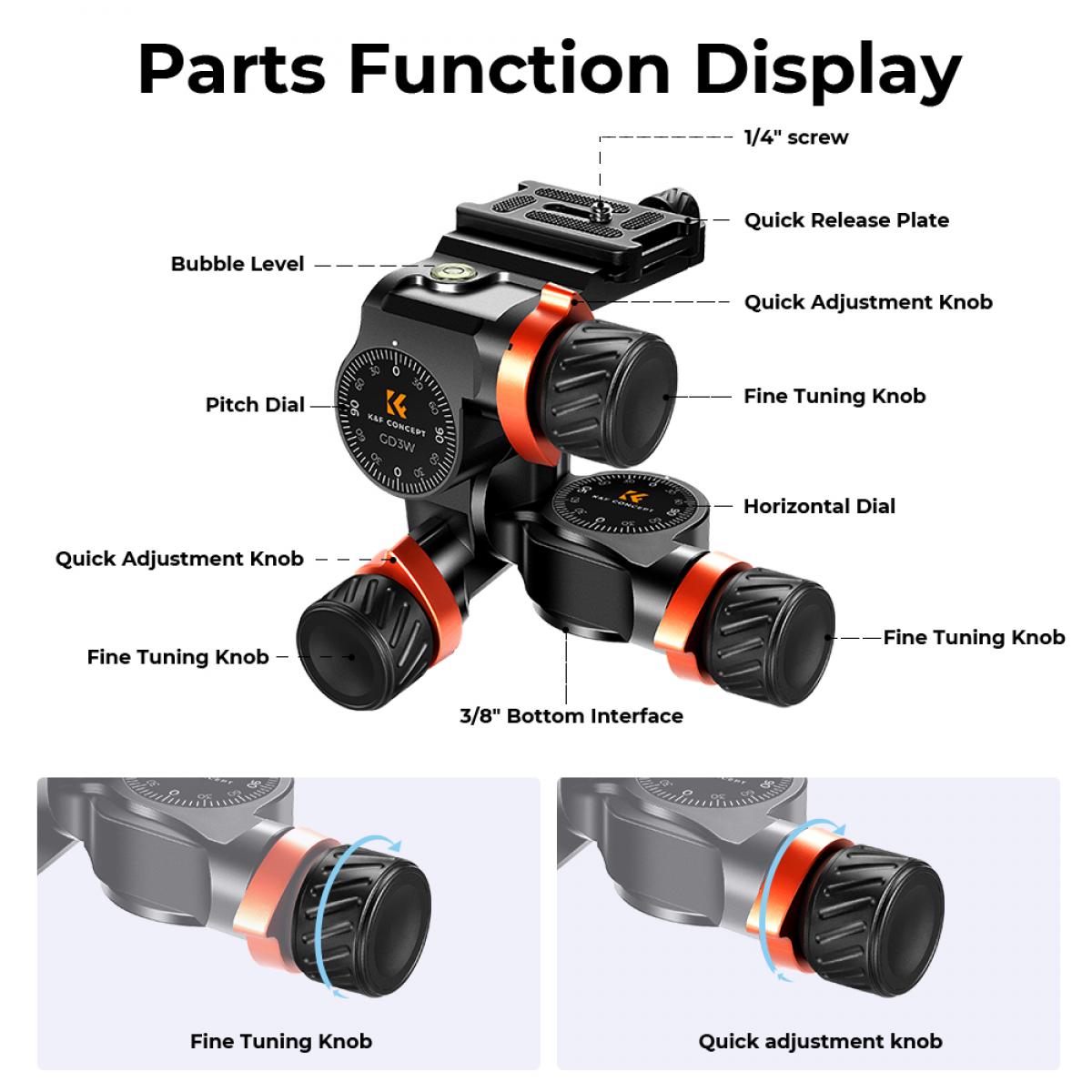
When you need absolute precision in framing, the kind where a millimetre shift ruins the composition, a geared head changes how you work. The K&F Concept KF31.047 gives you independent control over pan, tilt and roll through three separate adjustment mechanisms, each with dual-speed operation: a quick-release lever for rough positioning and a micro-adjustment knob for fine-tuning. That separation matters because you're never fighting all three axes at once, and when you release either control, the head locks exactly where you left it. No drift, no creep, no chasing the frame.
Independent Axis Control
Most ball heads force you into a trade-off: loosen the lock to reframe, and you're managing pan, tilt and roll simultaneously. Front-heavy setups droop the moment you unlock. You tighten it down, check the frame, realise it's off by a fraction, loosen again, and the whole cycle repeats. A geared head eliminates that loop. Each axis operates independently. Adjust pan without touching tilt. Dial in roll without disturbing your horizon line. The camera stays exactly where you put it between adjustments, so you're refining one variable at a time instead of wrestling three.
Dual-Speed Adjustment on Every Axis
Each axis offers two controls. The quick-release lever unlocks that axis completely, letting you swing the camera into rough position, useful when you're moving between subjects or recomposing from scratch. Once you're close, the micro-adjustment knob takes over. It moves the camera in tiny increments, the kind of shift you need when aligning a vertical line with the edge of the frame or nudging a product shot so the label sits dead-centre. The gearing ratio means you're working in fractions of a degree, not the coarse jumps a ball head gives you. When you let go of either control, the axis locks immediately. No lag, no settling, no second-guessing whether it held.
Where Geared Heads Solve Real Problems
Architectural work is the obvious use case. You're shooting a building facade, and the vertical lines need to be perfectly parallel to the frame edges. A ball head makes that a guessing game; a geared head makes it methodical. Loosen tilt, rough it in, then micro-adjust until the lines align. Same principle applies to macro photography, where depth of field is measured in millimetres and the difference between sharp and soft is often a matter of repositioning the focal plane by a hair. Product photography and food styling benefit for the same reason: the client wants the label readable, the garnish in a specific spot, the light catching the surface just so. You're not chasing the frame; you're building it one controlled adjustment at a time.
Panoramic landscape shooters rely on geared heads for multi-frame stitches. When you're capturing overlapping frames to merge in post, each frame needs to share the same horizon line and vertical alignment. A ball head introduces variance between shots, tiny shifts you don't notice until you're stitching and the seams don't line up. A geared head keeps the tilt and roll locked while you pan through the sequence, so every frame shares the same geometry. The result is cleaner stitches and less correction work later.
Astrophotography is another domain where lock-and-hold matters. You're framing a specific section of sky, often with a telephoto or telescope, and any drift between exposures means misaligned stars in your stack. The geared head's positive lock on all three axes means the frame you set at the start of the sequence is the frame you'll have an hour later.
Construction and Load Capacity
The head is CNC-machined from aluminium alloy, which keeps weight reasonable without sacrificing rigidity. The gearing mechanism is metal-on-metal, not plastic bushings that wear out or introduce play over time. The 6kg load capacity covers most mirrorless and DSLR bodies with mid-range zooms or primes. It's not built for super-telephoto wildlife setups, but for the genres where geared heads excel, macro, architecture, product, astro, the typical rig falls well within that range. A full-frame body with a 24-70mm f/2.8 or a macro lens and focus rail sits comfortably.
The base features a standard 3/8-inch thread, compatible with most tripod centre columns and levelling bases. The camera platform uses a quick-release system, so you're not threading a screw every time you mount or remove the camera. The platform itself includes a bubble level for initial setup, useful when you're establishing a level baseline before you start micro-adjustments.
What You Give Up Compared to a Ball Head
Speed. If you're shooting events, sports, wildlife, anything that requires rapid reframing, a ball head is faster. One lock, swing the camera, tighten, shoot. A geared head requires deliberate operation. You're not going to track a moving subject with it. The trade-off is intentional: you're exchanging speed for precision, and that trade makes sense when the subject isn't moving and the frame needs to be exact.
Weight is another consideration. Geared heads are heavier than ball heads of equivalent load capacity because of the gearing mechanism. The KF31.047 isn't a backpacking-weight accessory. It's a tool you bring when the shot requires the control it offers, not when you're counting grams on a multi-day hike.
Why the Lock-and-Hold Behaviour Matters
The mechanical lock on each axis is immediate. When you release the micro-adjustment knob, the worm gear engages and the axis stops. There's no gradual settling, no waiting to see if it holds, no need to over-tighten and risk shifting the frame. That predictability changes how you work. You make an adjustment, check the frame, make another adjustment, check again. Each step is additive. You're not re-solving the same problem every time you touch the head.
For photographers coming from ball heads, the first session with a geared head often feels slow. You're learning a new muscle memory: which knob controls which axis, how much rotation translates to how much movement in the frame. But once that's internalised, the control becomes intuitive. You're not thinking about the head anymore; you're thinking about the composition, and the head is simply executing your intent without introducing variables.
The K&F Concept KF31.047 delivers that control at a price point that makes it accessible to enthusiasts and working professionals who don't need the premium features of higher-end geared heads but do need the core functionality: independent axis control, dual-speed adjustment, and positive lock. It's built for photographers who've hit the limits of what a ball head can do and need a tool that prioritises precision over speed. If your work involves still subjects, exact framing, and compositions where a millimetre matters, the KF31.047 is worth the weight and the learning curve.