
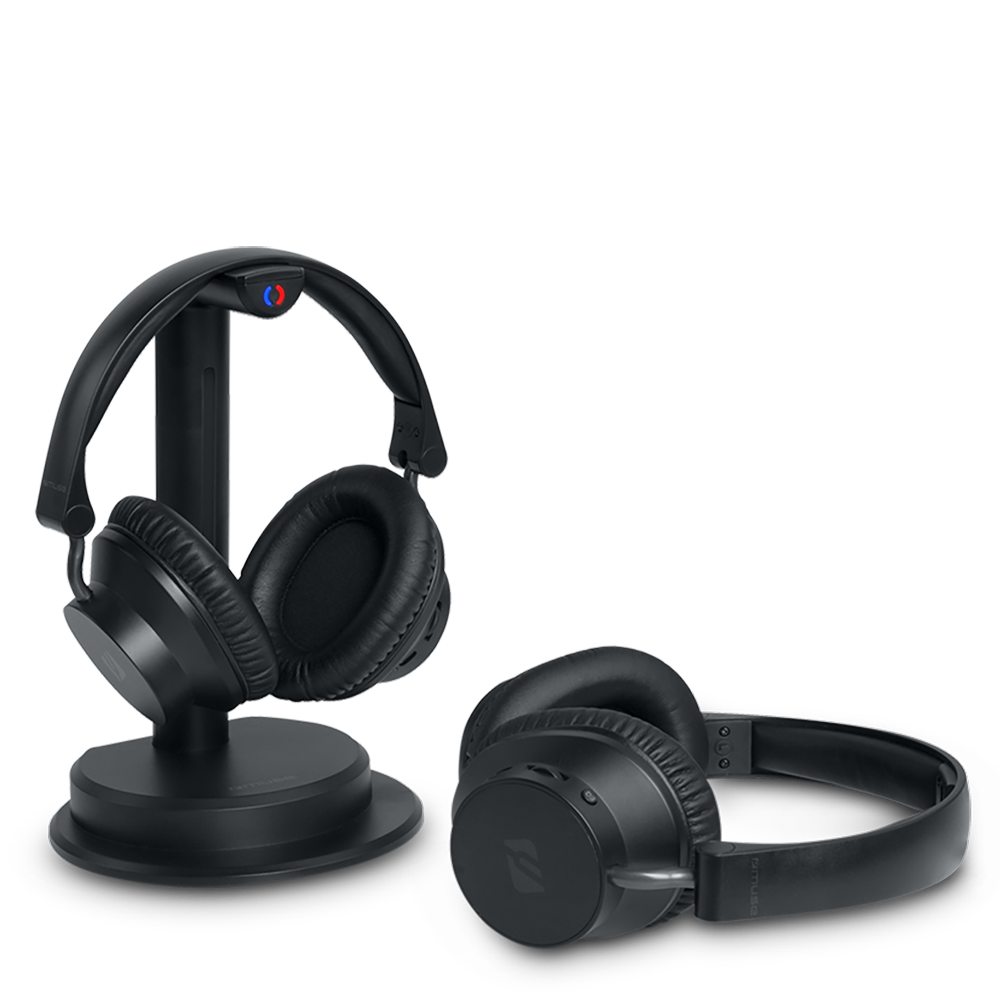


MUSE Dual Wireless TV Headphones for Two People with Charging Base
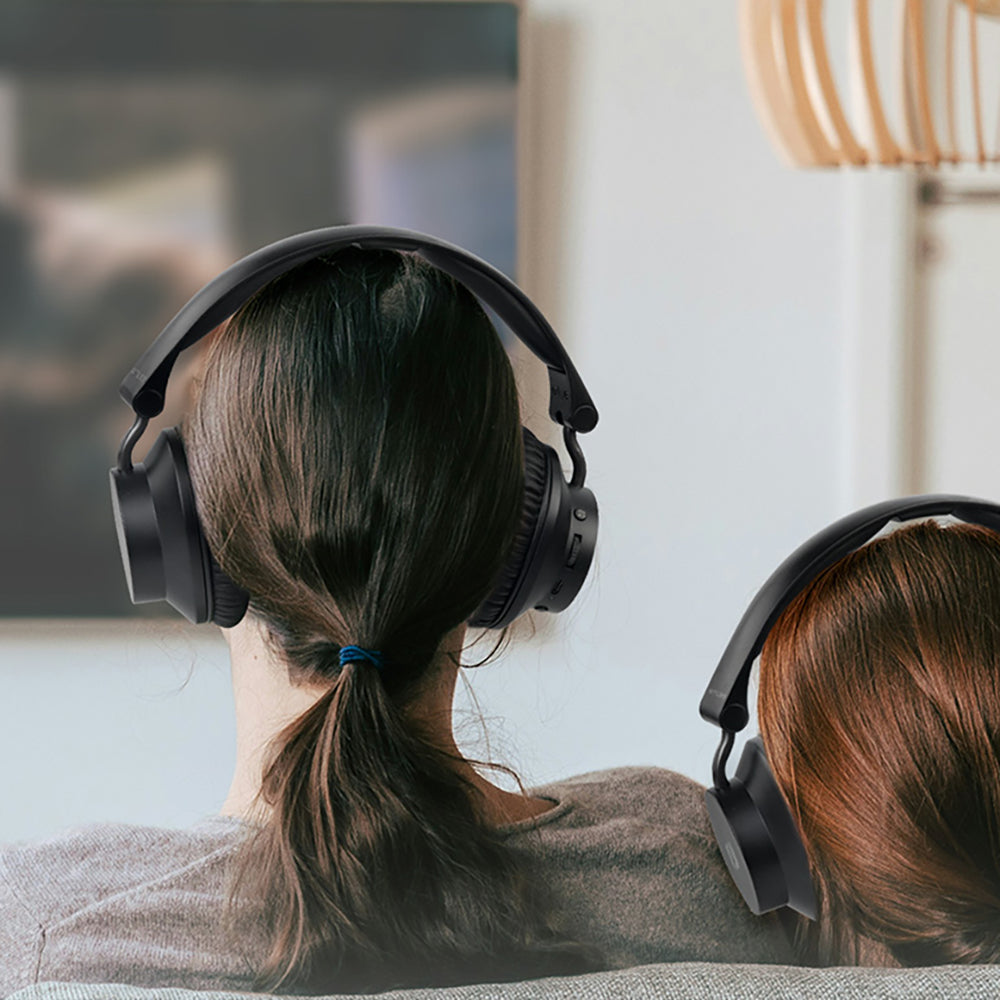
When two people share a living room but need different volume levels to follow a programme comfortably, the usual compromise leaves one person straining to hear and the other wishing it were quieter. The MUSE M-288 CTV solves that by giving each viewer their own wireless headphone with separate volume, balance and tone settings, all fed from a single transmitter that sits beside the television. Both people hear clearly, neither disturbs the household, and no one has to choose between following the dialogue and keeping the peace after nine o'clock.
Dual headphones, individual settings, no compromise
This is a two-headphone system. Both units receive audio simultaneously from the base station over a 2.4 GHz wireless link, which avoids the interference and dropout issues that plague cheaper alternatives. Each headphone operates independently: one viewer can set the volume high and switch the EQ to voice-clear mode to catch every word of a period drama, while the other keeps the volume moderate and selects full-range sound for a richer tone during a concert film. The controls sit on each headphone, so adjustments happen without negotiation or reaching across the sofa. It is the difference between watching together and watching in parallel.
Balance adjustment for uneven hearing
Age, infection history and simple biological variation mean many people hear better through one ear than the other. The M-288 CTV includes a left-right balance dial on each headphone, letting you shift the stereo image so both ears receive equal intelligibility even when one side is weaker. Most TV headphone systems omit this control entirely, assuming symmetrical hearing. For anyone who has spent an evening tilting their head to favour the stronger ear, the balance dial is not a luxury,it is the feature that makes long viewing sessions tolerable.
Three EQ modes and an amplifying microphone
Dialogue intelligibility drives most TV headphone purchases, and the M-288 CTV addresses it with three selectable EQ profiles. Normal mode delivers flat response across the frequency range. Voice-clear mode lifts midrange frequencies where speech sits, making it easier to parse dialogue in news broadcasts, courtroom dramas and anything with overlapping voices or background music. Full mode restores bass and treble for films with orchestral scores or action sequences where you want the low-end rumble and high-frequency detail. The amplifying microphone function, activated by a button press, lets you hear someone speaking in the room without removing the headphones. When a partner asks a question mid-programme or the doorbell chimes, press once to bring room sound into the mix, then press again to return to the television feed. It avoids the constant on-off cycle that breaks immersion.
Thirty-hour runtime and a charging dock that keeps both units ready
Each headphone holds an 800mAh lithium-ion cell that runs for up to thirty hours between charges,a full week of evening viewing for most households. The base station doubles as a charging dock: pogo-pin contacts on the headband cradle connect automatically when you hang the headphones on the stand, so they recharge overnight without cables or separate adapters. The dock is visible, intuitive and eliminates the drawer-full-of-chargers problem. You sit down, lift the headphones off the stand, and they are charged and ready. No battery anxiety, no hunting for leads.
Connects to most televisions without requiring technical knowledge
The base station accepts three input types: 3.5mm analogue, twin RCA phono, and optical digital. Cables for all three are included. This covers the vast majority of televisions in UK homes, from older sets with only RCA outputs to modern panels that offer optical only. Plug the appropriate cable into the TV's audio output socket, connect the other end to the base station, and audio flows to both headphones. The target buyer for this product is not technical and does not want to troubleshoot settings menus. The M-288 CTV works out of the box for most setups.
Optical connection requires PCM audio format
If you connect via optical cable and hear constant noise instead of programme audio, the television is likely outputting Dolby or DTS format, which the base station does not decode. Enter the TV's audio settings menu and change the output format to PCM, sometimes labelled Stereo or Linear PCM. The noise will stop once the format matches. This is a common pain point with TV headphone systems, and it is worth checking the audio menu before concluding the product is faulty. PCM is a standard format; most televisions support it, but it may not be the default.
Bluetooth for everyday use beyond the television
Both headphones support Bluetooth 5.3, so they pair with smartphones, tablets and computers for music, podcasts and phone calls when you are not watching television. This turns them into general-purpose wireless headphones for the rest of the day: listen to a radio programme in the garden, take a call in the kitchen, stream an audiobook from a tablet. When a call arrives while you are watching TV, the base station audio pauses automatically and the call takes priority. Press the power button to answer or end the call, then resume the programme. The dual-mode design means you are not buying a product that sits idle except during evening viewing.
Who this is for
The M-288 CTV suits households where two people watch television together but need different volume levels to follow dialogue comfortably. It fits homes where one person has age-related hearing loss and the other does not, where one person is recovering from an ear infection, or where both viewers simply want to watch late without waking children or housemates. It works for couples where one person wants the sound louder and the other finds that level uncomfortable, and for anyone who has spent years compromising on volume because the alternative was separate rooms. The charging dock, long runtime and simple connection process make it a practical choice for buyers who want a solution that works without requiring them to manage settings or remember to plug things in.
The MUSE M-288 CTV gives two people the freedom to hear the television clearly at their own preferred volume, with independent balance and tone controls, up to thirty hours of runtime per charge, and a charging base that keeps both headphones ready to use. Order the M-288 CTV and watch together again, without compromise.